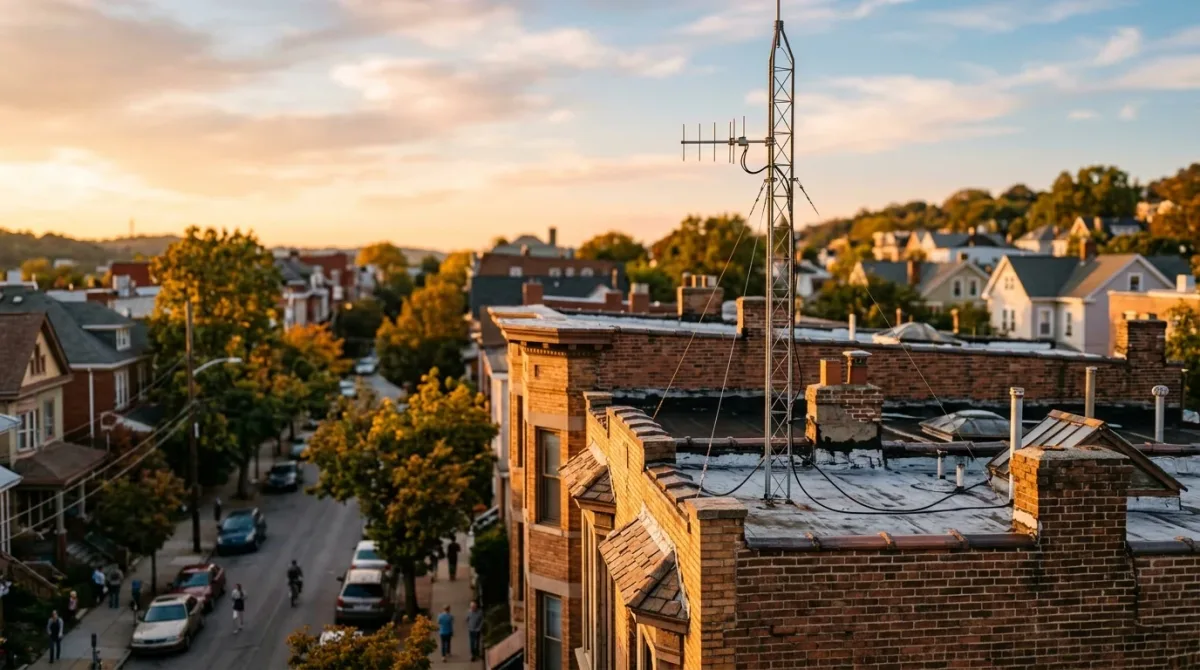
A community group can get a low-power FM license only during specific application windows the Federal Communications Commission opens for noncommercial applicants — schools, nonprofits, tribal governments, and local public-safety agencies — who plan a station reaching roughly a 3.5-mile radius at up to 100 watts, at no cost to file.
That's the LPFM service in outline, but the details decide whether a church basement collective, a high school broadcasting club, or a neighborhood arts nonprofit actually ends up on the dial. The rules are narrower than they sound, and they explain a lot about why community radio clusters where it does — dense in some regions, thin in others, and dependent on windows that open only occasionally.
What is LPFM, and who's allowed to apply?
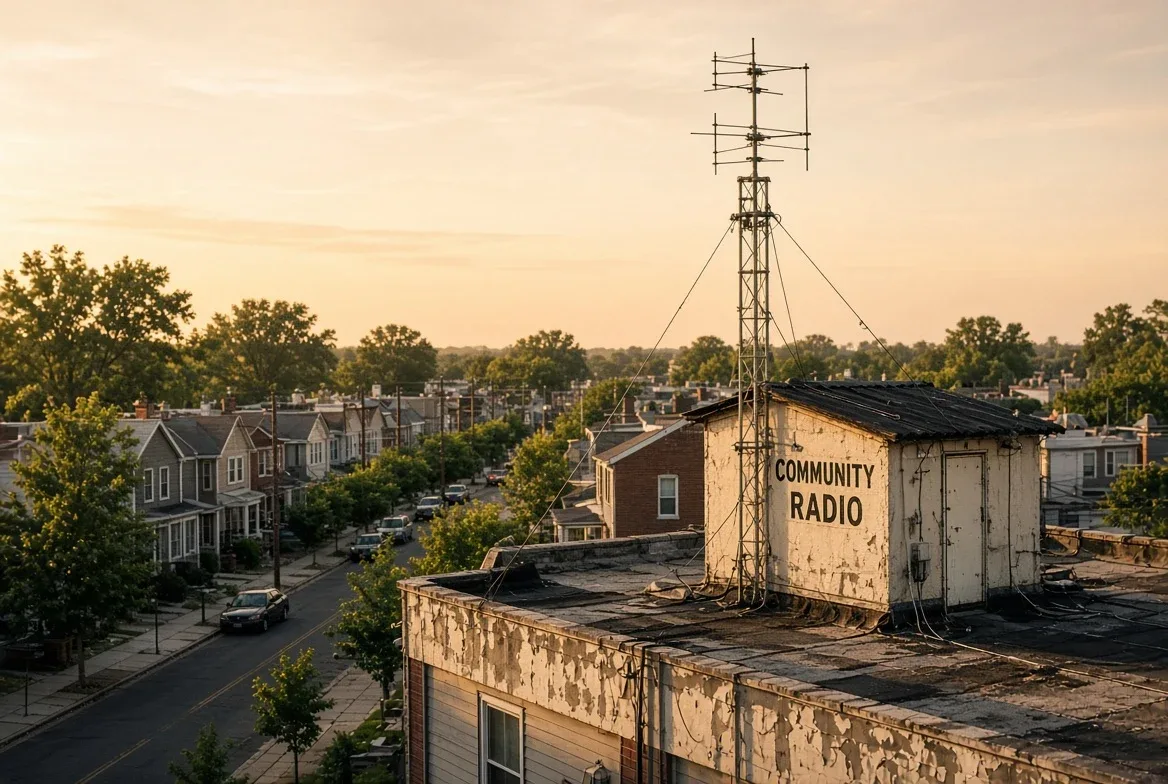
Low-power FM is a noncommercial broadcast license class the FCC created specifically for local, community-based groups rather than individuals or companies. The FCC's consumer guide to the service lists the eligible applicant types: nonprofit educational institutions, other nonprofit organizations with an educational purpose — community groups, faith-based organizations, disability service providers — and government or nonprofit entities running public safety or transportation services, plus Indian and Alaska Native tribes serving their own land.
The eligibility line is drawn just as clearly on the other side. "LPFM licenses cannot be issued to individual or commercial entities," the FCC states, and current commercial broadcasters, cable operators, and newspaper publishers are excluded outright. There's also a residency test: an applicant needs a headquarters or campus within 10 miles of the proposed transmitter site — 20 miles outside the top 50 radio markets — or a governing board that is at least 75 percent local by that same standard.
How much power does an LPFM station get, and how far does it reach?
An LPFM station is capped at 100 watts of effective radiated power, which the FCC's guide translates into real-world terms: a service area with a radius of roughly 3.5 miles, or 5.6 kilometers. That's a fraction of a full-power FM signal, which is the tradeoff built into the service — LPFM exists to fill a local, block-by-block or neighborhood-by-neighborhood niche that commercial and public radio's wider signals don't reach, not to compete with them for regional audience.
The ceiling isn't just technical. It's also why LPFM stations tend to sound the way they do: hyper-local news, a single school's or congregation's programming, or a specific immigrant or diaspora community's music and language — content built for a radius small enough that most listeners could, in theory, drive to the transmitter.
How does the application process actually work?
Applicants can't file whenever they're ready. The FCC only accepts new LPFM applications during discrete filing windows that it announces in advance — at least 30 days' notice, per the agency's guidance — and it opens those windows only periodically, sometimes years apart. The most recent new-station window ran from December 6 through December 13, 2023, after the agency pushed back an initially announced November 1–8 window and extended a filing freeze that had begun September 1, 2023, according to the FCC's LPFM FAQ.
Filing itself carries no fee — "there is no cost to file an application," the FCC's guide notes — and applications go in through the agency's electronic system during the window only. Outside of a window, there's no application to submit; a group has to wait for the FCC to open the next one, which is part of why the service has grown in irregular bursts rather than a steady trickle.
What happens when two groups want the same frequency?
When more than one qualifying application competes for the same spot on the dial, the FCC breaks the tie with a points system rather than a lottery. The agency's FAQ describes point credit for factors including an applicant's two years of established community presence, a commitment to eight hours of local programming a day, and a plan to maintain a publicly accessible main studio. If applicants still end up tied after points are counted, the FCC's FAQ says they're encouraged to work out a voluntary time-share arrangement; failing that, the agency's Media Bureau assigns each selectee its own operating hours on the shared frequency.
One more restriction shapes who shows up in these contests: groups that already own FM translator stations are generally barred from applying for LPFM permits, though the FCC's FAQ notes narrow exceptions allowing ownership of up to two translators under certain conditions — a rule aimed at keeping the service oriented toward genuinely new, local broadcasters rather than existing station operators expanding their footprint.
Who has actually used LPFM to put new stations on air?
| Applicant type | Eligible? | Example under FCC criteria |
|---|---|---|
| Nonprofit educational institution | Yes | A high school or community college |
| Other local nonprofit, educational purpose | Yes | A faith-based organization or arts nonprofit |
| Government/nonprofit public safety or transit body | Yes | A volunteer fire department |
| Tribal government or entity | Yes | A tribe broadcasting on its own lands |
| Individual | No | Not eligible under any circumstance |
| Existing commercial broadcaster or newspaper owner | No | Excluded to keep the service local and noncommercial |
Much of the connective tissue between the FCC's rulemaking and the groups who've actually filed traces back to advocacy organizing that predates the service itself. Prometheus Radio Project, founded in 1998 by veterans of Radio Mutiny — a pirate station that had been broadcasting without a license in West Philadelphia — describes on its own history page how it pushed the FCC to legalize the kind of low-power community broadcasting its founders had been doing illegally, then pivoted from piracy into applicant support. The organization says it has run twelve multi-day "radio barnraisings" where volunteers build a station's physical plant in a few days, and that it helped more than 100 groups apply during the 2007 full-power window and assisted dozens more during the 2010 filing round.
That history is a reminder that LPFM's rules on paper — the 100-watt cap, the 10-mile residency test, the points system — are only half the story. The other half is the pattern of who actually organizes in time for a window that might not reopen again for years, and who's willing to do the unglamorous work of drafting an engineering exhibit and a community-of-license statement before the clock runs out.
For a related artists perspective, read How a Song Actually Gets Added to College Radio Rotation.
For more context, read The fund will participate in ReBuild Ukraine in Warsaw to hear the needs of the communities.
For more context, read ukraine.