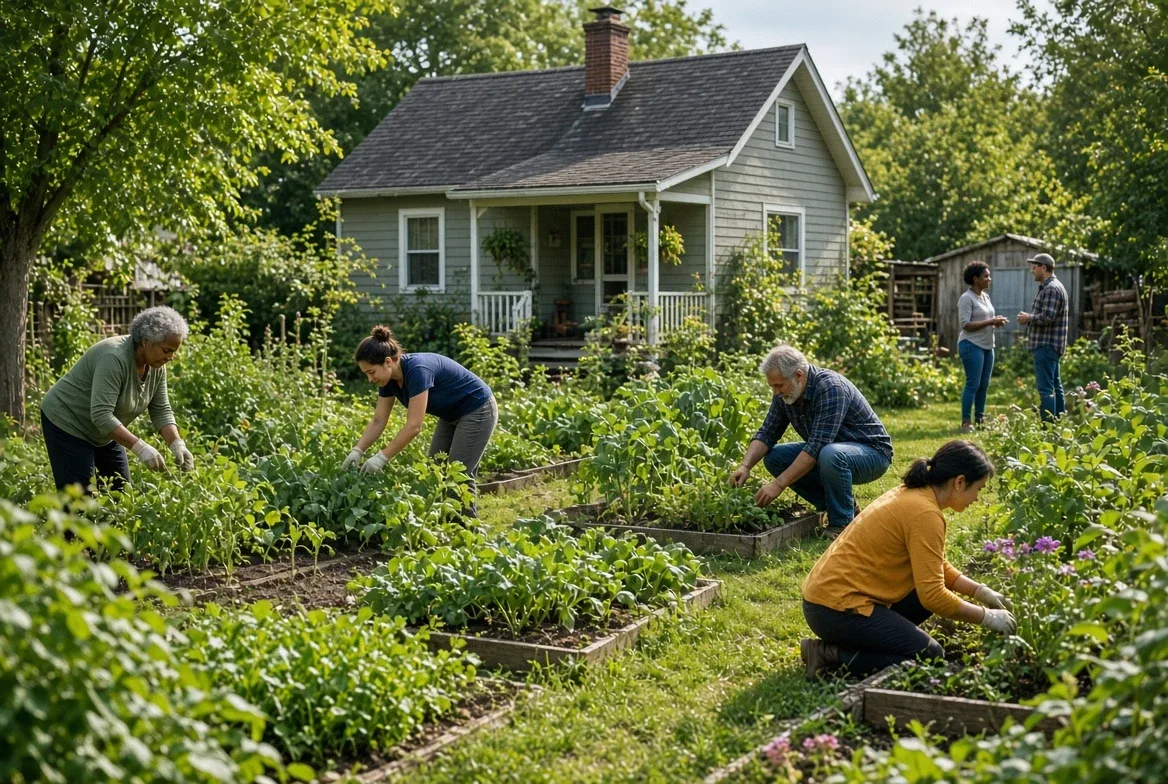
A community land trust keeps a home affordable for good by splitting what a buyer pays for: a nonprofit holds the land forever, and the family buys only the house sitting on it, on a long-term lease that is often renewed for 99 years, according to Grounded Solutions Network, the national organization that supports the model. That one split is why prices in a land trust stay reachable for the next family, and the one after that.
What actually gets split when a family buys into a land trust?
In a typical sale, a buyer pays for land and structure together, and both can climb with the market. A community land trust removes the land from that equation. The nonprofit keeps title to the ground permanently; the homeowner buys the house and leases the land underneath it for a term that runs decades, commonly 99 years and renewable, per Grounded Solutions Network. Because the buyer isn't purchasing the land, the purchase price is lower from the start — often tens of thousands of dollars below a comparable market-rate home in the same neighborhood.
The homeowner still gets the things that make ownership matter day to day: they live in the house, they can renovate it, they pass it to their kids if they choose, and the lease renews rather than expiring on them. What they give up is the right to sell the house for whatever the market will bear.
How does the resale formula keep the price low for the next buyer?
When a land trust homeowner sells, the price is restricted by a formula written into the ground lease — the homeowner agrees to sell at a capped price to keep the home affordable in perpetuity, though they can still recover value from improvements they've made to the property, according to Grounded Solutions Network. That formula is the mechanism that makes "permanently affordable" more than a slogan: without it, the first sale under the trust would be affordable and every sale after would drift back toward market rate.
The trade-off is real, and land trusts don't hide it. A homeowner builds some equity — enough, in many cases, to move up. Reporting from TIME found that roughly 60% of community land trust homeowners eventually go on to purchase a market-rate home, meaning the model functions for many families as a stepping stone into ownership rather than a permanent ceiling.
Who actually runs a community land trust?
Community land trusts are nonprofits, and most are governed by what's known as a tripartite board — one-third residents who lease from the trust, one-third other community members, and one-third public or professional representatives, so that no single interest controls the organization, per Grounded Solutions Network. That structure is meant to keep the trust answerable to the people living on its land, not just to funders or city hall.
Where did this idea come from?
The model traces to 1969, when Black farmers and civil rights organizers founded New Communities in Albany, Georgia, as a collectively owned farm built to protect Black land ownership from the displacement that had followed generations of racist housing policy — TIME identifies it as the project "often credited as the original model" for today's community land trusts. Christie Peale, chief executive of New York's Interboro Community Land Trust, told TIME that the trusts exist "as a response to our country's long history of racist housing policy and social and economic injustice." That origin still shapes who the model serves: TIME reports that homeownership is the single strongest driver of wealth-building for low-income and minority households, which is the gap land trusts are built to close.
Christin Carter, who bought her home through Portland's Proud Ground land trust in 2011 as a single parent, described what the security meant to her family in an interview with TIME: "Being able to draw tick marks up the wall as my kids get taller… the gift of stability and pride is just something that I could never repay."
Has the model actually held up anywhere?
Boston's Dudley Triangle is the case land trust advocates point to most often. In 1988, residents of the Roxbury neighborhood organized as the Dudley Street Neighborhood Initiative won a rare power for a community group: the Boston Redevelopment Authority granted their land trust, Dudley Neighbors Incorporated, the authority to use eminent domain to acquire vacant, privately owned parcels across the roughly 62-acre Dudley Triangle, according to Dudley Neighbors Incorporated's own history of the project. Residents used that power against the neighborhood's own blight — clearing abandoned lots — rather than the more familiar use of eminent domain to displace people.
A quarter-century later, more than 30 acres of that land had become 225 permanently affordable homes, plus a greenhouse, an urban farm, and shared recreational space, Dudley Neighbors Incorporated reports. It's cited widely as one of the country's most successful urban community land trusts, and as a template for the eminent-domain approach other neighborhood groups have since studied.
How many of these exist, and is the model growing?
As of January 2024, 308 community land trusts were operating across 48 states, Washington, D.C., and Puerto Rico, per TIME's reporting on Grounded Solutions Network data — up from 289 in 2021, 225 in 2018, and 162 in 2006. The growth has come with a track record: during the 2008 foreclosure crisis, TIME reported, land trust homeowners saw significantly lower delinquency and foreclosure rates than the market at large, evidence that the model's price caps also function as a stability net when the broader housing market doesn't.
For neighborhoods worried about being priced out of the communities they built, the land trust model doesn't promise fast homeownership. It promises a formula that outlives any single housing cycle — land held in common, prices held down, and a lease that keeps renewing instead of running out.
For a related inclusion perspective, read The Hiring Credit for Veterans and Job Seekers With Records Just Lapsed.