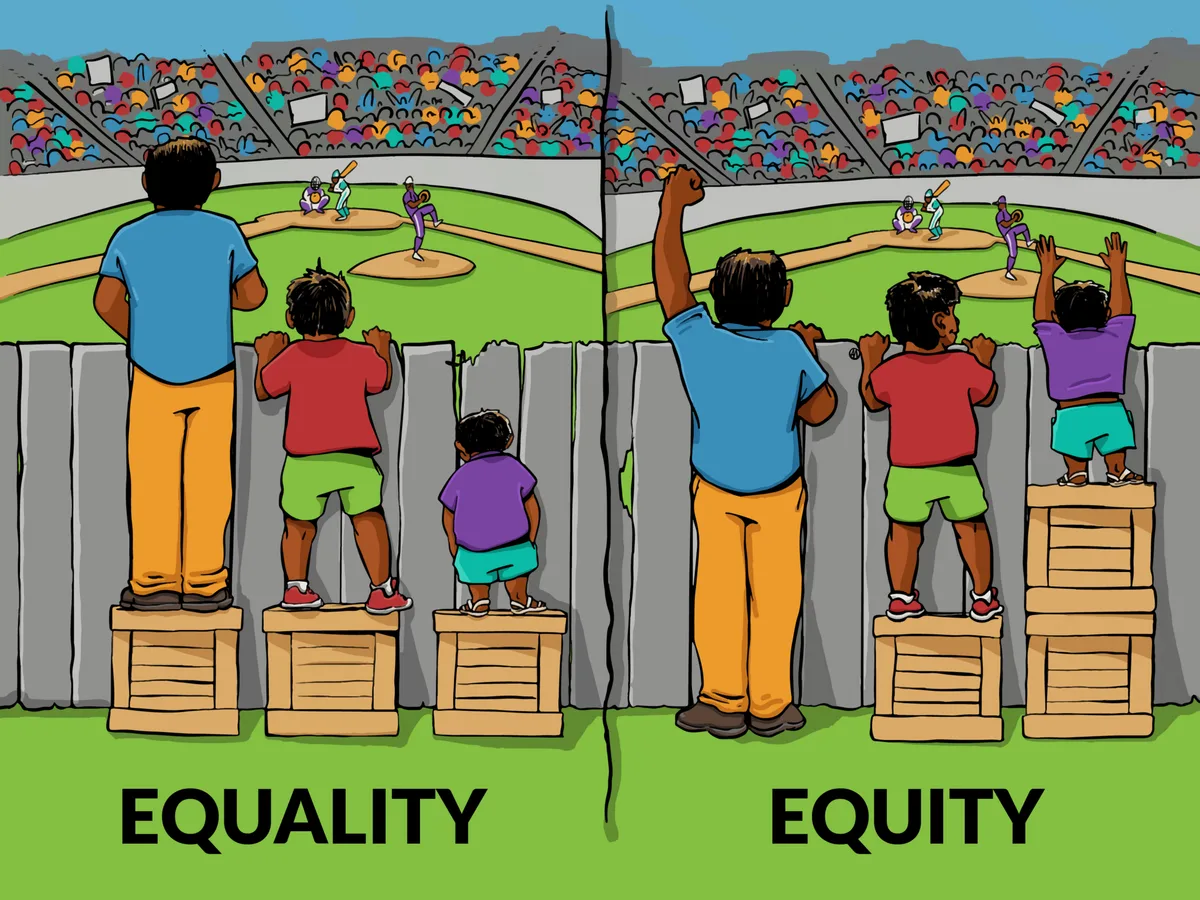
Equality in sports is still a work in progress. Women athletes train the same hours, break the same records and carry the same injuries as men — yet they often earn less, appear on screen less and get fewer chances to play at all. The tilt shows up in three places: money, coverage and opportunity.
This explainer walks through each of those gaps, why they persist, and what actually moves them. One caution up front: the fix is rarely giving everyone the identical thing. As United Way NCA puts it, equality means everyone gets the same resources regardless of circumstance, while equity allocates resources based on need — and in many cases, identical treatment can deepen the gap rather than close it.
What does equality in sports actually mean?
Equality is a contested idea, and philosophers have spent centuries pulling it apart. The Stanford Encyclopedia of Philosophy notes that any claim of equality has to answer a question first: equal in what respect? Applied to sports, that question gets concrete fast. Equal in pay? In playing time? In media attention? In who gets a scholarship, a contract or a field to practice on?
Most people mean something simpler: that a girl who loves soccer and a boy who loves soccer should have the same shot at going as far as talent and effort can take them. That is equal opportunity in the plain sense. The harder part is that opportunity is built on infrastructure — leagues, facilities, coaching pipelines, broadcast deals — and infrastructure reflects decades of investment decisions that favored one side.
So when advocates talk about equality in sports, they usually mean a bundle: fair pay for the work performed, comparable resources for training and competition, and visibility that lets the next generation see what is possible. Each piece moves at its own speed.
Why does the pay gap in sports persist?
The headline numbers in top-level professional sports have long favored men, and the reasons are layered. Revenue is the usual explanation: men's leagues drew bigger broadcast contracts earlier, and those deals compound. But revenue is not a neutral fact of nature. It is shaped by who got the airtime first, who got the marketing budget, and who got the institutional support when the leagues were young.
There is also a structural wrinkle that mirrors the workplace. Pay transparency changes behavior — it is the same logic behind salary-range posting laws, which we covered in What Workers Actually Gain When the Salary Range Is Posted. When compensation is secret, inequity hides. When it is public, someone has to defend it. Athletes who unionize and negotiate collectively have been among the most effective at forcing that conversation, because a collective bargaining agreement puts the numbers on the table for everyone on the roster.
Prize money is a cleaner fight than salary, and it has moved faster in many sports because it is visible, public and easy to compare. Salaries, bonuses and endorsement structures are messier — and that is where the tilt tends to survive longest.
Why does coverage matter so much?
Coverage is not just a mirror of interest. It is a maker of interest. A sport that is not broadcast is a sport people cannot follow, cannot bet on responsibly, cannot buy tickets to on a whim, and — crucially for the pipeline — cannot imagine themselves into. A ten-year-old who never sees a woman pitch a perfect game has one less reason to keep pitching.
This is where the equality-versus-equity distinction earns its keep. Giving men's and women's sports the identical marketing budget sounds equal. It is not equitable, because men's sports start with name recognition, established broadcast relationships and a century of highlight reels. As United Way NCA argues, identical allocation can increase inequity when groups start from different places. Closing a coverage gap usually means investing more where the deficit is, at least for a while.
The pattern shows up at every level, from youth leagues deciding which field gets the good lights to national federations scheduling championship matches in smaller venues. Each decision seems small. Stacked over a generation, they decide who gets seen.
Where does opportunity still fall short?
Opportunity gaps start earlier than most people think, and they are less about rules than about logistics. A team needs a place to practice, a coach who shows up, transportation that exists, and a schedule that fits around school and work. Our reporting habit here at Equality Weekender is to measure inclusion in concrete terms — bus routes, ramp angles, meeting times — because those are the things that decide whether a kid actually gets to play.
Facilities are the quiet story. When a school or a municipality funds one set of fields and lets the other set degrade, the gap is written in turf and fencing. Scheduling is another: prime slots go first to the programs with the most institutional pull, and the program that gets the 9 p.m. practice time loses families who cannot get there.
Access also runs through disability and cost. A sport is not equal if the registration fee, the equipment and the transportation assume a family with a car, flexible hours and spare income. The same principle that governs workplace accommodations — adjust the conditions so people can actually participate — applies to a league schedule and a locker room. We covered that logic in How Workplace Accommodations Actually Work Under the ADA, and it translates almost word for word to sports: participation is the right, and the environment either honors it or quietly denies it.
What this means: what actually moves the needle
Our analysis of the evidence points to three levers that consistently shift the field, and none of them require waiting for a heroic moment.
- Visibility with investment behind it. Broadcast deals, streaming access and highlight coverage of women's competition build the audience that later justifies bigger contracts. Coverage first, revenue follows — not the other way around.
- Transparency. Published pay scales, published facility budgets and published schedules make inequity arguable in public. What can be compared can be contested.
- Collective voice. Players who organize — through unions, associations or simply coordinated public statements — have historically moved pay and conditions faster than individual appeals, because institutions respond to leverage, not sentiment.
There is also a role for the rest of us, and it is unglamorous: show up. Buy the ticket, watch the broadcast, coach the team, ask the parks department why one field has lights and the other does not. Audiences and local budgets are the raw material of every gap described above, and both are made of individual decisions.
The long game, and what remains unknown
The evidence establishes a clear pattern: the gaps in pay, coverage and opportunity share a root cause — decades of unequal investment — and they respond to the same remedies: visibility, transparency and organized pressure. None of that is mysterious. What remains genuinely unknown is pace. Institutional change in sports has historically moved in jumps — a landmark agreement, a broadcast breakthrough, a generation of athletes who refuse the old terms — rather than in steady lines, and no one can say with confidence when the next jump arrives.
Equality in sports, in the end, is the same question this site keeps returning to across Equality News: who gets the resources, who gets seen, and who gets to decide. The playing field tilts wherever those answers stay unexamined. It levels wherever someone checks the math — and keeps checking it after the applause dies down.