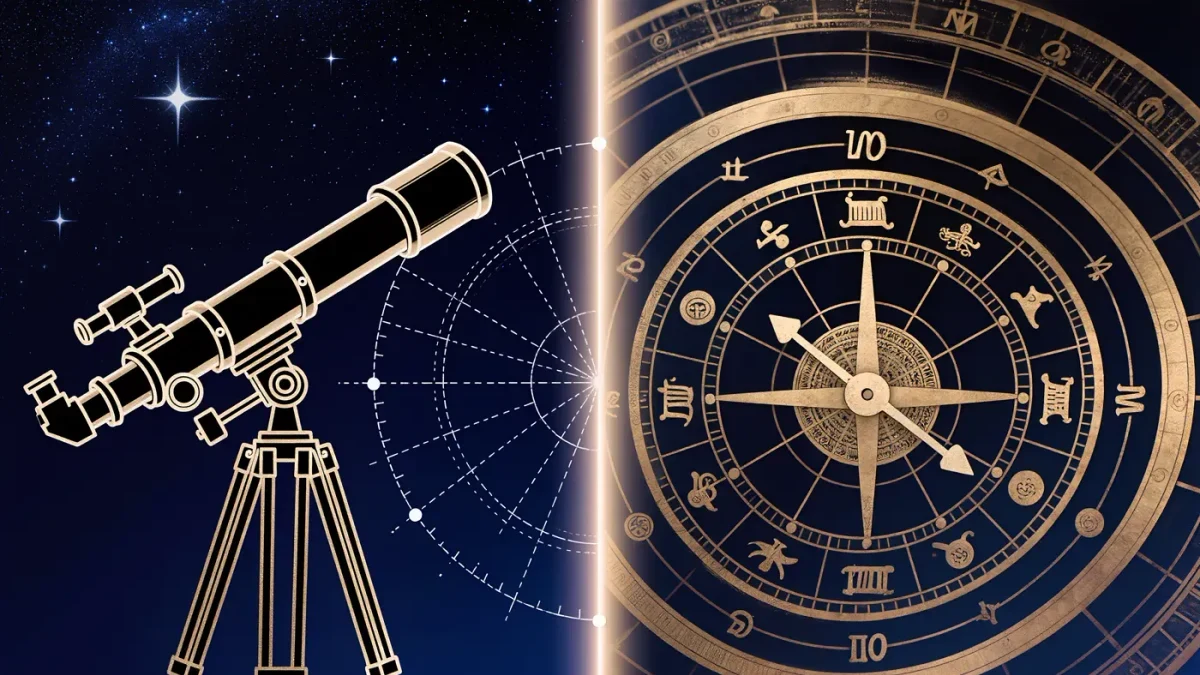
Astronomy is the scientific study of celestial objects: what stars are made of, how planets move, and how the universe evolves, tested by observation and mathematics. Astrology is the symbolic tradition of reading meaning into planetary positions, asking what the sky says about human character and timing. They share a vocabulary of signs and planets, which causes endless confusion, but they differ completely in method, evidence, and purpose. One predicts eclipses to the second and lands rovers on schedule; the other tells warm, ancient stories about what those eclipses might mean for a life.
Astrology is an entertainment tradition, not a science; Equality Weekender publishes it as lifestyle content, not prediction or advice.
Where did the two disciplines split?
For most of history they were a single practice. Babylonian priests logged planetary positions partly to read omens; the same records became the foundation of mathematical astronomy. The split came slowly, and decisively with the scientific revolution, when astronomers like Kepler, who cast charts himself, began finding physical laws that explained planetary motion without reference to human affairs. Astronomy kept the instruments and the method; astrology kept the symbolism and the calendar. The two still exchange vocabulary the way old houses exchange neighbors' ladders.
What does astronomy say that complicates astrology?
- Precession: the earth's axis wobbles over about 25,800 years, slowly shifting the zodiac against the stars, so the sign called Aries in newspapers no longer corresponds to the constellation Aries of the sky today.
- Gravity falls off fast: the pull of the obstetrician standing beside a newborn exceeds, in simple physical terms, the gravitational pull of Mars, which makes proposed force-based mechanisms implausible.
- Testing: controlled studies, from personality matching to headline predictions, have repeatedly found no effect beyond chance and cold reading.
So why does astrology still work for people?
Because it was never really competing on astronomy's terms. Astrology functions as a reflective ritual: it offers a structured vocabulary for self-description, a calendar of prompts for reflection, and a shared symbolic language that is genuinely beautiful, built from thousands of years of sky-watching. Psychologists point to effects like the Barnum phenomenon, where warmly general descriptions feel personally accurate, and to the simple usefulness of a mirror. None of that is fraudulent; it is just not science. A poem is not a failed lab report, and nobody grades sonnets on instrumentation.
What does each discipline actually do well?
Astronomy tells you when the next eclipse will occur, where the comet will be, and what a black hole is; its claims can be checked and its errors corrected, which is the whole engine of science. Astrology tells you a story in which you are the protagonist and the sky is the scenery; its claims are unfalsifiable by design, and its practitioners mostly know this, whatever the billboards imply. The trouble starts only when categories blur: horoscopes quoted as fact, or astronomy dismissed as arrogance. Both disciplines are at their best when each minds its own verb, one measuring and one meaning.
Can you enjoy both at once?
Easily, and most history's greatest sky-watchers did. Watch the meteor shower with an astronomer's knowledge of the debris trail, then read your chart that evening with an astrologer's appetite for metaphor, and nothing in either activity contradicts the other, provided you keep the labels straight. The rule of thumb this site follows: the moment a claim can be tested, hand it to astronomy; the moment a claim is about significance rather than measurement, you are in storytelling country. Know which country you are standing in.
What is the honest boundary?
It runs exactly between prediction and reflection. Astronomy predicts; astrology reflects. When anyone uses planetary positions to schedule surgery, time investments, or make decisions about health, money, or law, the boundary has been crossed into territory where the tradition has no demonstrated competence, and we decline to follow it there. Within its own fence, as language, ritual, and weekend entertainment, astrology harms no one and occasionally delights. The sky is large enough for both audiences: the ones with telescopes and the ones with charts, looking up at the same lights for entirely different and equally human reasons.