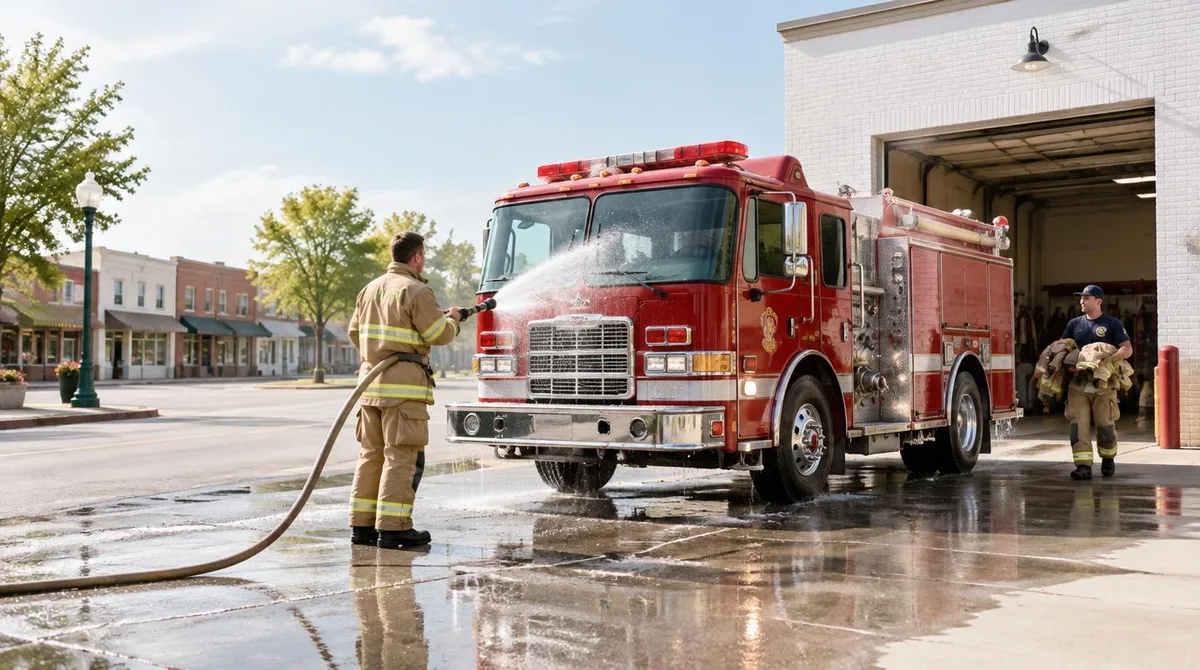
A volunteer fire department is exactly what the name says: a fire and emergency service staffed not by paid career firefighters but by residents of the community it protects. They train, they respond at 3 a.m., and they do it around day jobs. In many small towns and rural areas, they are the only fire and rescue service that exists.
What keeps these departments alive is not a paycheck. It is a mix of training hours, fundraising dinners, borrowed equipment, and a steady supply of neighbors willing to sign up. When that supply thins, the whole service model thins with it — a fact that has quietly become one of the most important stories in community services across the country.
This piece explains how a volunteer fire department actually works, who runs it, what the job asks of the people who do it, and what a community can do when the roster starts to shrink. For readers following how neighbors hold essential services together in other ways, our coverage of mutual aid networks that became first responders after the 2025 floods tells a similar story from a different corner of community life. This connects to our earlier piece, Mutual Aid Networks Became First Responders After the 2025 Floods.
How does a volunteer fire department actually work?
The mechanics are more formal than most people expect. A volunteer department is usually an organized nonprofit or a municipal service with officers, bylaws, training requirements, and response protocols. Members are on call rather than on shift. When a pager or siren sounds, whoever is available drops what they are doing and heads to the station or directly to the scene.
Training is the backbone. New members typically work through orientation and basic firefighter or emergency medical training before they respond to calls, and they keep up skills through regular drills. The specifics — age rules, screening, training hours, and application steps — vary by department, which is why the starting point for anyone curious is simply to ask their local department what it requires.
That pattern of local variation shows up across volunteer service generally. The Salvation Army describes how its own volunteer roles vary by location, shaped by local programs, current needs, and available support — and it directs prospective volunteers to confirm requirements like orientation, screening, and training with their local branch. A volunteer fire department works the same way: the national picture matters less than the local one.
Who are the people on the roster?
They are the town. Teachers, farmers, nurses, mechanics, retired folks, and people who work in the next county over and keep a radio in the truck. Some joined because a family member served before them. Some joined after a fire touched their own street. Most will tell you a version of the same thing: nobody else was going to do it.
The job is layered. There are the calls — fires, crashes, medical emergencies, weather damage. Then there is everything that makes the calls possible: maintaining equipment, cleaning the station, running the books, applying for grants, and organizing the pancake breakfast that replaces a worn hose. Many members carry more than one role. The person who drives the tanker may also be the treasurer.
What this means for a town is simple and often invisible until it fails. Every hour a volunteer spends is an hour the community did not have to fund, and every hour a volunteer cannot give is a gap with no immediate backup. Departments feel a thin roster not as an abstraction but as a slower response on a Tuesday afternoon when too many members are at work.
Why are departments struggling to recruit?
The pressures are structural, and none of them are mysterious. Modern work schedules are less compatible with being on call than the factory shifts of an earlier era were. Training standards have risen, which is good for safety but raises the cost of entry for someone with a full-time job and a family. Housing costs push people out of small towns, and the people who leave are often the people who would have joined. For related coverage, see The Land Trust Model Keeping Neighborhoods From Being Priced Out.
There is also a visibility problem. A generation ago, the siren on the water tower advertised the department every time it blew. Today, alerts land on phones, and younger residents may not know the department exists, or that it accepts members without prior experience.
Our analysis: recruitment rarely fails for one reason, and it rarely recovers through one fix. The departments that hold on tend to treat recruitment as an ongoing civic practice — open houses, junior programs for older teens where local rules allow them, flexible roles for people who cannot fight fire but can drive, cook, or handle logistics — rather than an annual plea.
What does the job ask of a volunteer?
Honesty matters here, because the job is real. It asks for training completed on your own time. It asks for interrupted dinners, missed school events, and cold hours on a highway shoulder. It asks members to work alongside people they may know intimately — which is a comfort in a small town and a weight at the same time, because the call on the other end of the radio might involve a neighbor's name.
It also asks for teamwork under rules, not improvisation. Fire service culture runs on clear command, checklists, and drills, and a good volunteer department is disciplined in exactly the way a paid one is. The volunteers who last are usually the ones who like that structure, not the ones who want to be a hero.
The reward, members consistently say, is proportionate to the cost: you become one of the people your town can count on, and everyone knows it. That standing is earned in the least glamorous way possible — by showing up.
What can a community do to help?
Practical steps, in rough order of how easy they are:
- Ask before assuming. Call the department or stop by on a drill night. Ask what they need — members, funds, equipment, or hands for a specific project. Needs differ town by town.
- Consider a supporting role. Not every volunteer carries a hose. Auxiliary members, drivers, and administrative helpers multiply what the responding members can do.
- Show up to the fundraiser. The chicken dinner is not quaint; it is budget. Attendance is a material contribution.
- Support the civic infrastructure around it. Volunteer services sit inside a wider web of local institutions. Learning how to read a city council agenda helps residents spot the funding and policy decisions that reach a fire station long before the siren does.
- Tell the story. Local coverage keeps a department visible. Communities that document their own civic life — whether through a fire department's open house or starting a community newspaper — make it easier for the next volunteer to find the door.
The pattern here echoes what we see across community services: when a formal institution strains, neighbors organize around it. Sometimes that takes the shape of a fire department auxiliary; sometimes it looks like the community fridges keeping food within reach in cities where other systems fall short. The instinct is the same.
Why this service model is worth understanding
A volunteer fire department is one of the clearest examples of a community choosing, year after year, to provide an essential service for itself. It is not nostalgia. It is logistics, training, and civic habit, held together by people who live on the same streets they protect.
The evidence for how these departments run — organized rosters, formal training, local fundraising, and requirements that vary from one town to the next — comes from the departments themselves and from the broader volunteer-service world they belong to. What remains unknown in any specific case is local: whether a given town's roster is growing or shrinking, and whether its leaders have a plan. The only way to find out is the old-fashioned one. Ask.