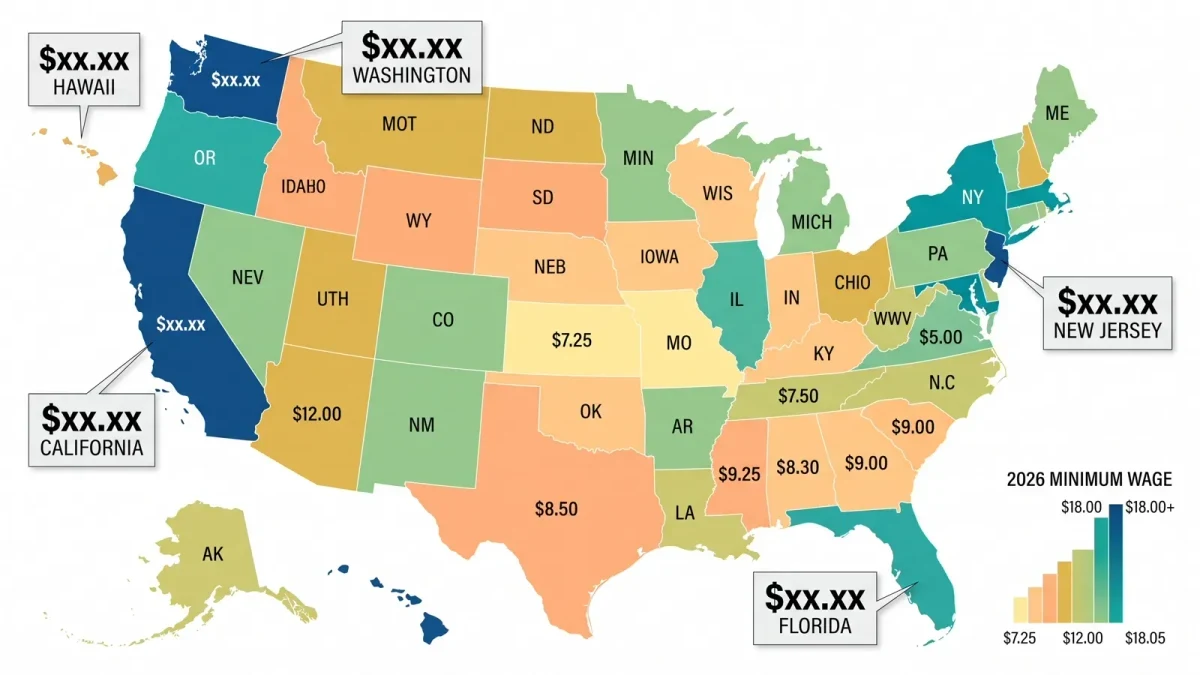
Nineteen states raised their minimum wages on January 1, 2026, lifting pay for an estimated 8.3 million workers, according to the Economic Policy Institute's annual roundup of state increases. California's floor rose to $16.90 an hour, six states crossed $15 for the first time, and New York City reached $16.00, making the new year one of the broader state-level pay increases since the post-pandemic wave began.
Which states crossed the $15 line for the first time?
Arizona, Colorado, Hawaii, Maine, Missouri, and Nebraska all reached or exceeded $15 an hour on January 1, 2026, EPI reported, joining the cohort of high-floor states that had previously been dominated by the West Coast and the Northeast. Michigan moved to $13.73 under its scheduled stair-step law, which is set to carry it to $15.00 by 2027. New York's upstate and Long Island tiers rose alongside the city's $16.00, and the remaining increases were spread across states with both inflation-indexed formulas and one-time legislative raises. The federal minimum, by contrast, stayed at $7.25, where it has sat since 2009.
Who actually received these raises?
EPI's estimates consistently show the beneficiaries skew toward workers in food service, retail, home care, and other service occupations, and toward women and workers of color, who are overrepresented in minimum and near-minimum wage jobs. That is why state wage policy is routinely treated as an equality policy by economists across the spectrum: a dollar added to the floor flows to a demographic profile that looks very different from the workforce average. Tipped-worker tiers rose in several states as well, an often-invisible line item that most coverage skips.
What does this change for low-wage communities?
For affected workers, the gains arrive in paychecks automatically, but two follow-on effects deserve attention. First, spillover: when a floor rises, employers typically need to lift wages somewhat above it to remain competitive, so the benefit extends beyond workers earning exactly the minimum. Second, annual indexing: many of these states tie their wage to inflation, meaning future January increases happen automatically unless a legislature intervenes, so the raises compound rather than erode. For community organizations, the practical task in the first months of a new floor is wage-theft enforcement, since violations tend to cluster where floors just jumped.
What is the context other coverage missed?
Most January roundups list the new numbers and stop. The under-covered story is the widening geography of the wage floor: with $15 now law in states as varied as Missouri, Nebraska, and Maine, the historical framing of high minimum wages as a coastal phenomenon is obsolete, and the effective national wage floor is increasingly a patchwork of state numbers rather than the federal $7.25. Economists at EPI note that in states without their own higher floor, the federal minimum still binds, and its real value has fallen by roughly a third since 2009 to inflation. That divergence, a rising bloc of indexed states against a stagnant federal number, is the structural fact that will shape the next decade of wage policy.
How can workers check their new rate?
The Labor Department's Wage and Hour Division publishes federal and state minimum wage reference tables, and each state labor department posts the official rates and tipped-worker tiers. Workers who believe they were paid below the floor can file a complaint with their state labor agency or the federal Wage and Hour Division.