The federal tipped minimum cash wage has been $2.13 an hour since 1991, under a tip-credit system that lets employers count tips toward most of the minimum wage they would otherwise owe. That number has not moved in more than three decades, which makes state law — not federal law — the main thing that determines a tipped worker's paycheck in any given place. This article is general information about how the system works, not financial or legal advice.
How does the tip credit work?
The federal minimum wage is $7.25 an hour, but federal law allows employers of tipped workers to pay a direct cash wage of $2.13, taking a credit of up to $5.12 from tips to close the gap. If tips do not make up the difference, the employer must pay more so that the combined total reaches $7.25. In theory, no tipped worker's base can fall below the full minimum; in practice, enforcement depends on accurate record-keeping and reporting, which is where wage theft complaints concentrate.
Only tips actually received count, and the rules apply to customarily tipped occupations — servers, bartenders, bussers in many cases. Since 2018, federal rules have also addressed tip pooling, allowing sharing among back-of-house staff at employers that pay the full minimum without a tip credit, subject to conditions that have shifted between administrations.
Why do states differ so much?
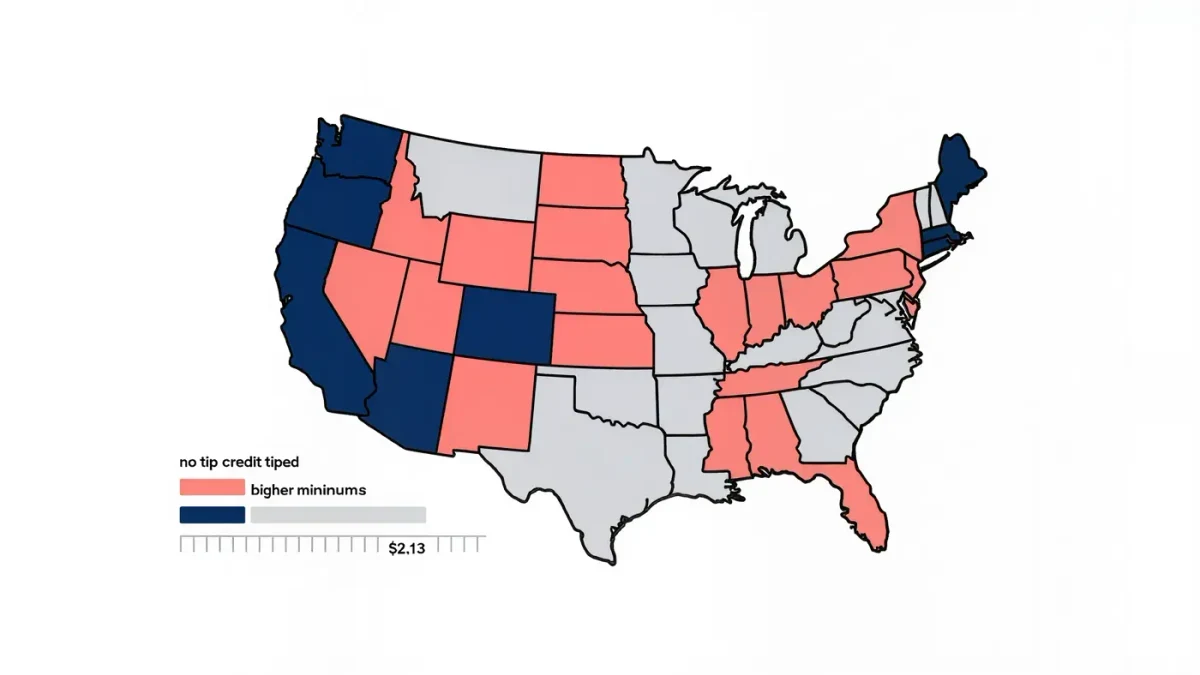
Because states may set their own standards, and they cluster into three broad patterns:
- No tip credit at all — the employer pays the full state minimum in cash, and tips belong to the worker on top. Seven states have long taken this route: Alaska, California, Minnesota, Montana, Nevada, Oregon and Washington.
- A higher tipped cash wage with a partial credit — many states require more than $2.13 but still allow some credit, so the tipped wage sits somewhere between the federal floor and the full state minimum.
- The federal pattern — a number of states, largely in the South, simply follow the $2.13 cash wage with a credit up to $5.12.
What does that look like state to state?
Exact figures change as legislatures act and minimums index with inflation, so treat any table as a snapshot and confirm current rates with the state labor department or the U.S. Department of Labor's wage listings. The shape of the map, as of 2025-2026:
| Approach | Typical examples | What tipped workers get |
|---|---|---|
| No tip credit | AK, CA, MN, MT, NV, OR, WA | Full state minimum in cash, often well above the federal level, plus all tips |
| Higher tipped wage, partial credit | NY, MA, WA-cohort states like CO, AZ, VT, ME and others | A cash wage set above $2.13 but below the state minimum, with tips counted toward the remainder |
| Federal-style $2.13 | AL, LA, MS, SC, TN, WY and several others | $2.13 cash wage, tips credited up to the $7.25 federal minimum |
The gap between the first and third rows is the entire debate. In one row, a slow Tuesday still pays a full wage; in the other, a slow Tuesday can approach the federal floor.
What are the arguments?
Supporters of eliminating the tip credit argue that it shifts the cost of wages from employers to customers' discretion, leaves workers exposed to slow seasons and harassment they cannot afford to report, and produces higher poverty rates among tipped workers — claims advanced in research by labor-policy groups, including analyses associated with the Restaurant Opportunities Centers United.
Restaurant industry groups counter that removing the credit raises labor costs sharply, encourages employers to replace tipping with service charges, and can reduce reported tip income as prices change. Studies of tip-credit changes in states like New York and of the minimum wage literature more broadly have found employment effects smaller than critics predict, though contested and sensitive to local conditions.
Voters have occasionally had the last word. Michigan raised its tipped wage schedule by ballot initiative; Maine voted by referendum to phase out its tip credit, then saw legislators modify the implementation — a reminder that this policy area moves in both directions.
What should a tipped worker actually know?
Three practical points. First, whichever rule applies, the combined cash wage plus tips must reach the applicable minimum — federal, state or local, whichever is highest. Second, if tips are pooled, ask which pool: federal rules distinguish pools among traditionally tipped staff from extended pools at full-wage employers. Third, wage and hour complaints can be filed with the state labor agency or the U.S. Department of Labor's Wage and Hour Division, and retaliation for filing is illegal.
Overtime is its own trap: for tip-credit employees, overtime is computed on the full minimum wage with the credit recalculated, not on $2.13 — an arithmetic error that shows up often in back-pay settlements.
What about service charges and no-tipping experiments?
Parallel to the wage fight, some restaurants have replaced tipping with built-in service charges or hospitality-included pricing, following well-known experiments by prominent restaurateurs over the past decade. The results have been mixed — some operators returned to tipping after backlash or logistics problems — and the law adds wrinkles: service charges generally belong to the employer unless the policy says otherwise, while tips, once given, are legally the worker's under federal rules.
For diners, the practical point is to read the menu's fine print before double-tipping; for workers, to ask how a service charge is distributed. The tipping system and the wage floor interact in ways no single rule covers.
Is anything changing?
The federal tipped minimum has been frozen at $2.13 through every Congress since 1991, and proposals to raise or phase it out have repeatedly stalled. The action remains in the states, where legislatures and ballot measures continue to move tipped wages in both directions, and in cities that set local minimums above their state's.
For diners, the practical takeaway is humbler: the same tip buys very different take-home pay depending on which side of a state line the table sits. The system is not one system. It is fifty-plus of them, sharing a federal floor set three decades ago.