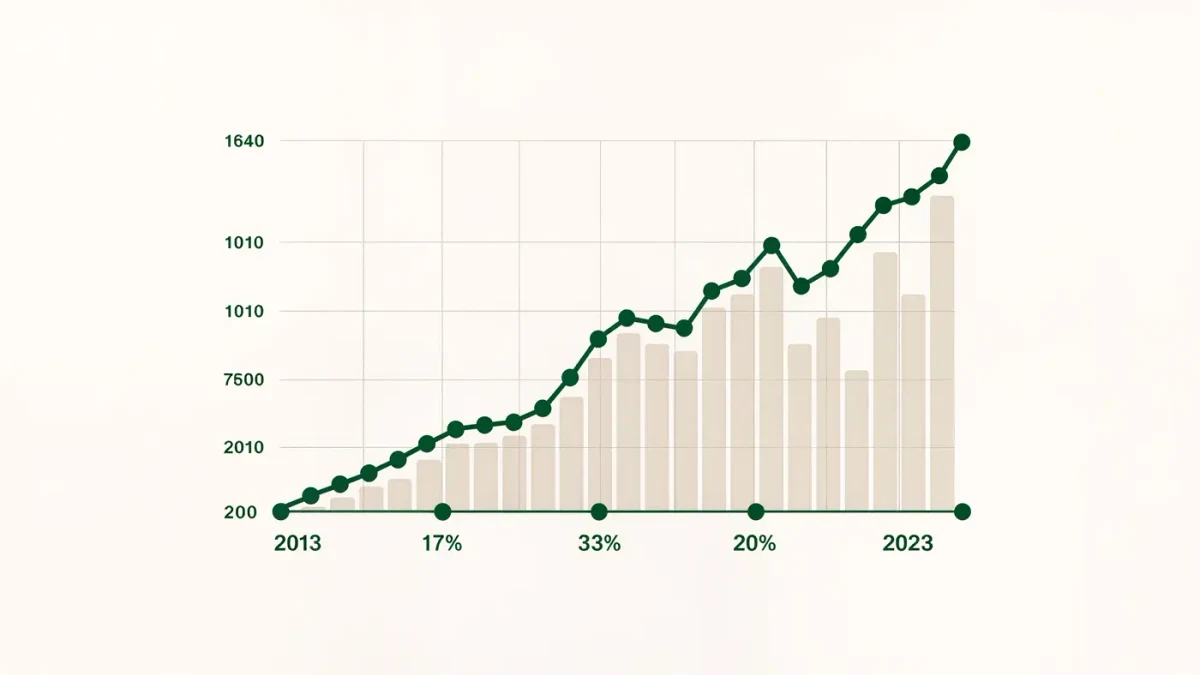
A record 55 women lead Fortune 500 companies, 11 percent of the newest ranking of America's largest businesses by revenue, Fortune reported with the release of the 2026 list, an all-time high that still leaves nearly nine of ten of the country's biggest firms led by men. In Congress, women hold about 28 percent of seats in the 119th Congress, 155 members across both chambers, essentially unchanged from the previous session, according to Pew Research Center's analysis of congressional membership.
What do the corporate numbers show?
The Fortune 500 CEO count has been climbing slowly and unevenly: 9 percent in 2024, 11 percent in the 2025 list, and a record 55 women, again 11 percent, in 2026, per Fortune's annual count. The plateau within the record matters as much as the record itself, because a one-point gain followed by a flat year suggests the pace is glacial rather than compounding. Catalyst's global tracking adds context: worldwide, women lead about 34 companies on the Fortune Global 500, under 7 percent, with none at the very top of the ranking. Researchers who study the pipeline, including Catalyst and the Forté Foundation, consistently point to the same bottleneck: women reach middle management at parity-adjacent rates but exit or stall before the officer-level roles that feed CEO searches.
What about women in political leadership?
The congressional picture is a record plateau. Women hold roughly 28 percent of voting members in the 119th Congress, about 29 percent of the House and 25 percent of the Senate, Pew found, flat compared with the record-setting 118th Congress. The forward-looking indicator is more dynamic: a record 590 women have filed to run for the U.S. House in the 2026 midterms, according to counts tracked by Rutgers University's Center for American Women and Politics, surpassing the previous high of 583. Filing is not winning, and winning is not holding power, but candidate pipelines have historically been the leading indicator of seat gains.
What does this change for women early in their careers?
Representation data can read as abstractions, but it functions as information: studies of role-model effects suggest visible women in top roles changes application and ambition patterns among younger women, and the difference between 11 percent and 28 percent maps where those signals are strongest. The practical takeaways for individuals are the ones research consistently supports: sponsorship, meaning a senior advocate who spends political capital, not just mentorship that spends time; line-of-business roles with P&L responsibility, which remain the standard CEO prerequisite and where women remain underrepresented; and board experience, which the record shows is a common on-ramp to the executive suite for women who reach it.
What is the context other coverage missed?
The standard story reports each number separately, corporate here, congressional there. The missing frame is that both measures have stalled in the same narrow band for multiple cycles, around one in nine and around one in four, which points to a structural rather than a pipeline-only problem. Women have been roughly half of the college-educated workforce for two decades, first-round candidate pipelines set records, and entry-level hiring at large firms is near parity, yet the senior ranks barely move year over year. That pattern is what researchers call the broken rung, the missing step from manager to senior manager, and it is the single point where intervention, transparent promotion criteria, structured sponsorship, and accountability for slates, has the best-documented returns. Reading the CEO count and the congressional share side by side makes that shared shape visible.
Where can readers track these numbers?
Fortune publishes its annual women-CEO count with each year's list, the Congressional Research Service's membership profile of the 119th Congress carries the official chamber breakdowns on Congress.gov, and CAWP at Rutgers maintains the definitive databases on women candidates and officeholders.