Every polling place in the United States that offers a federal ballot must, by law, have at least one accessible voting system for people with disabilities — a requirement Congress wrote into the Help America Vote Act of 2002, alongside mandates for the ability to vote privately and independently. On top of that, federal law guarantees the right to assistance from a person of your choice and prohibits states from charging voters with disabilities or older voters for registration. Those rules apply in all 50 states, the District of Columbia and the territories, whatever the local election office's budget or preference.
This article explains the legal floor for general understanding. EQUALITY WEEKENDER publishes information, not legal advice; voters facing a specific barrier on Election Day should contact their local election office or a voting-rights hotline immediately.
What does the Help America Vote Act require?
The Help America Vote Act — HAVA, passed after the 2000 election — is the modern backbone of accessible voting. Its Section 261 required states, as a condition of federal funding, to ensure that every polling place have at least one direct-recording electronic voting system or equivalent accessible device installed by January 2006. The device must allow voters with disabilities — including those who are blind, deafblind or have limited dexterity — to vote privately and independently. The law also required states to make polling places physically accessible, with the modest exception of cases where no accessible location is available, in which jurisdictions must offer curbside voting or another alternative means.
Before HAVA, voting privately was often impossible for a blind voter: the standard method was asking a poll worker or family member to mark the ballot. The law's insistence on privacy and independence is the part disability advocates fought hardest for, because a ballot someone else fills in is a ballot always slightly in doubt.
What does an accessible voting system actually look like?
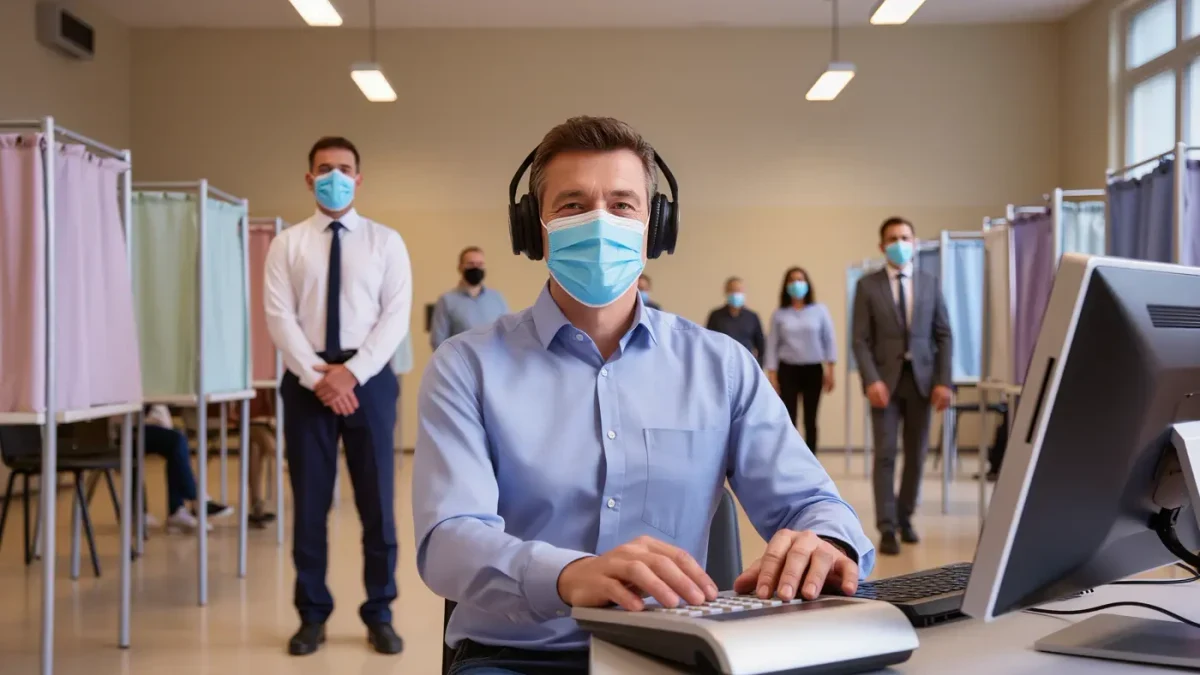
In most precincts today the accessible machine is a ballot-marking device: the voter inserts a blank ballot, and interacts with the machine through a touchscreen, a tactile keypad with Braille labels, an audio interface through headphones, or a sip-and-puff controller. The machine marks the printed ballot, which is then scanned or deposited like any other. Features typically include adjustable text size, high-contrast and screen-reader audio readouts of the full ballot in the voter's language, and pacing controls so the audio can be slowed or repeated.
Two practical notes. First, the accessible machine is available to any voter who wants to use it — no proof of disability is required. Second, poll workers are supposed to be trained to explain the device and set it up on request, and voters who find an untrained crew can ask for the polling place's accessibility information or call the election office. Asking for the machine early in the day, when lines are short, is a common recommendation from voting-rights groups.
Who can help you vote, and who cannot?
Federal law allows a voter who needs assistance — because of disability, blindness or inability to read or write — to receive help from a person of their choice, with two exceptions: the voter's employer or an agent of the employer, and an officer or agent of the voter's union. That protection predates HAVA, reaching back to the Voting Rights Act of 1965, and it covers reading the ballot, explaining procedures and physically marking the ballot at the voter's direction. Poll workers may also assist, but they cannot influence the vote.
Election offices themselves must provide assistance under the ADA, since voting is a state and local government function covered by Title II. That includes sign-language interpreters or other effective communication on request, materials in accessible formats where feasible, and physically accessible polling places — entrances without stairs, doorways wide enough for wheelchairs, accessible parking and routes. A precinct placed up a flight of stairs with no lift is not a minor lapse; it is a civil-rights violation.
What about voters who cannot leave home or a facility?
For voters in hospitals, nursing homes or with conditions that make travel impossible, states offer a patchwork of alternatives, and federal law sets some common ground. Where no accessible polling place exists, curbside voting must be offered under HAVA: poll workers bring a ballot to the voter's car. Most states run absentee or mail voting programs open to voters with disabilities, and several permit a voter with a disability to return an absentee ballot electronically or with the help of an authorized assistant. The details differ sharply by state — deadlines, who can return a ballot on someone's behalf, and whether a doctor's note is required — so checking the state election office's accessibility page well before an election is worth the ten minutes.
What can a voter do if a polling place turns them away?
Barriers still appear: a broken machine, an accessible entrance locked on Election Day, a poll worker refusing an interpreter. The fastest remedies are layered. Ask the polling place's named accessibility contact or the head election judge on site. Call the local election office while the problem is happening. Beyond that, the US Election Assistance Commission and state election agencies handle complaints, disability-rights legal organizations run voter hotlines each federal election cycle, and complaints under the ADA or HAVA can be filed after the fact. Even when a fix comes too late for one election, complaints are what drive machine maintenance and poll-worker training before the next.
Why the floor matters
Access to voting did not arrive by drift. The Voting Accessibility for the Elderly and Handicapped Act of 1984, the Voting Rights Act, the ADA and HAVA each moved the floor upward, usually after disabled veterans, blind voters and disability organizations sued or testified. The current baseline — one accessible machine per polling place, private and independent voting, help from a person of your choosing — is a legal minimum, not a ceiling. States can and do exceed it, with electronic ballot delivery, accessible marking tools online and uniform training. But no state can go below it, and knowing the floor is the first step to standing on it.