The most telling change in New York City's parks over the past decade is not any single ramp. It is a design philosophy: a program called Parks Without Borders, launched by the city's Department of Parks and Recreation in 2015, which took the fences, steps and locked edges that kept parks sealed off from their sidewalks and reimagined them as continuous, open ground. The approach draws on universal design, a framework formalized by the architect Ron Mace in the 1980s with a deceptively simple demand: build environments usable by all people, to the greatest extent possible, without adaptation. When a park department adopts that idea, the results show up in places most visitors never notice — and in who shows up at all.
Why the edge of a park matters more than its interior
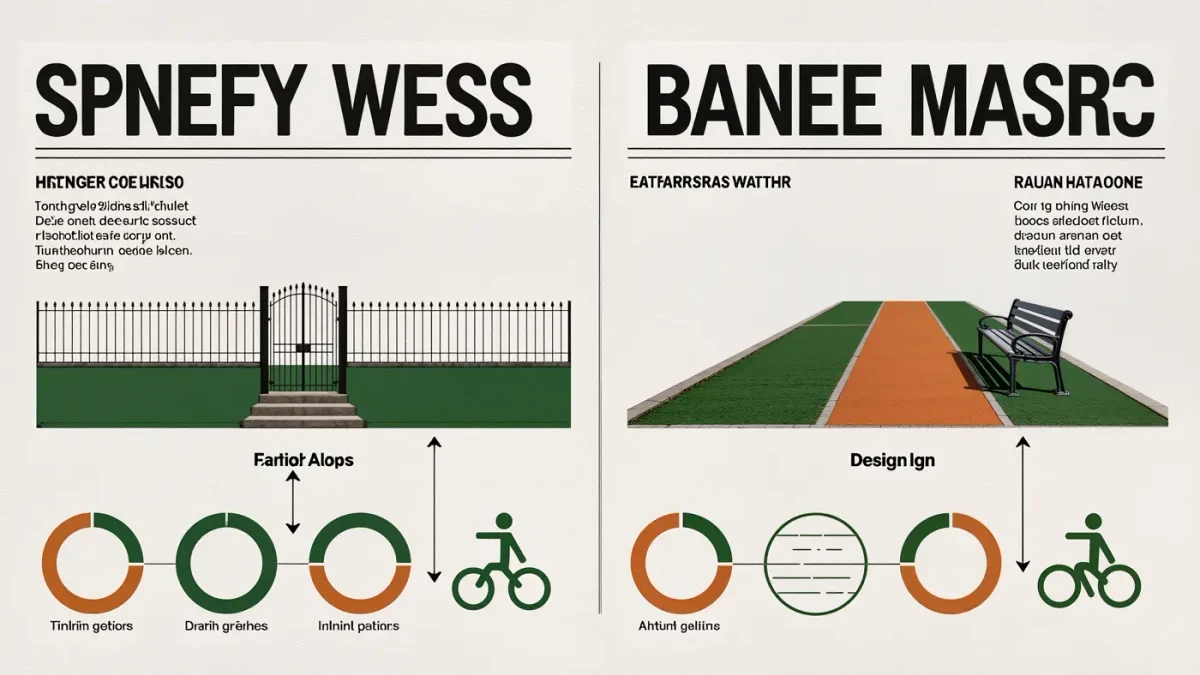
Parks Without Borders began from an observation park staff knew firsthand: the perimeter is where parks fail. A historic iron fence with a single gated entrance, a stair-step at a corner, a planting bed that funnels visitors into mud — each one filters out wheelchair users, parents with strollers, older adults with canes, delivery workers on a lunch break. The program's signature move was to lower or remove perimeter barriers, open sightlines from the street, and raise the park's grade to meet the sidewalk so that entering requires no decision at all. You simply keep walking.
City planners elsewhere recognized the shift because it inverted the usual order of operations. Traditionally, a park was designed, built, and then retrofitted for compliance — an access ramp added where a lawsuit or a complaint demanded it, after the fact. Universal design flips the sequence: the needs of the widest possible range of bodies are on the table at the sketch stage, and the ramp is never built because there is no step in the first place.
What the retrofit looks like on the ground
Walk a redesigned entrance and the elements read as ordinary good design rather than accommodation. Paved paths with gentle grades that a wheelchair user, a toddler and a runner share without anyone being labeled. Seating at intervals short enough for someone with limited stamina, with backs and armrests that make standing up possible again. Shade structures and drinking fountains at reachable heights. Restrooms with turning space wide enough for a chair, doors that open without a grip-and-twist. Signage with high-contrast type set at heights readable from a seated position.
Under the Americans with Disabilities Act, public entities like park departments must maintain transition plans documenting how they will make facilities accessible, and the design language of those plans has evolved in the same direction New York took voluntarily: fewer bolted-on fixes, more whole-environment thinking. The distinction matters in daily use. A compliant ramp to a playground set apart behind a fence technically meets a standard; a path that carries everyone into the same space together meets the point.
Who actually benefits?
The honest answer of universal designers is: everyone, at different moments. The demographic reality is that disability is not a fixed population but a condition that most people touch — temporarily through injury, permanently through age, chronically through illness. A curb-free entrance serves a wheelchair user on Tuesday and a mover with a dolly on Wednesday and a runner with a sprained ankle on Thursday. Park departments that track usage consistently find that removing barriers grows total visits, because ease of entry was never a niche need.
There is also a quieter social effect. When a park has one specially built accessible entrance and a dozen ordinary ones, disabled visitors arrive marked as different, routed through the infrastructure designed for them. When every entrance is the accessible entrance, that marking dissolves. Advocates describe this as the difference between being welcomed and being expected.
What the change costs — and what it asks
Retrofitting edges is not free, and cities that have done it are candid that the work competes with leaking roofs and broken play equipment for capital budgets. What the universal design argument changed is the accounting. A design that works for more people from day one avoids the double cost of building wrong and rebuilding later, and park departments that adopted the philosophy report that the inclusive version of a detail — a path, a bench, a gate — rarely costs dramatically more than the exclusionary one when it is chosen early.
The harder ask is cultural. Compliance thinking rewards checking a box; universal design rewards arguing about how a space will actually be used, which requires park staff to talk to the people who were not using it. Community engagement — meeting older adults who stopped coming because there was nowhere to rest, parents of disabled children who drove to the next town's park — is where the design briefs came from, in New York and in the cities that followed its lead.
What other cities can take from it
The transferable lessons are unglamorous and specific. Audit edges before interiors, because entry is the first barrier. Prefer continuous surfaces over ramps, and shared spaces over designated ones. Buy benches and fountains and signage off a universal-design standard list rather than project by project, so inclusion becomes procurement rather than debate. And publish the plan, because a transition plan that residents can read is one they can hold a department to.
The deepest change is harder to photograph. Before universal design, a park's message to a disabled resident was conditional: you may come, through that gate, by that route. The retaught park says something plainer. It says the space was drawn with you in it from the first line — and the crowd at the open edge on a warm evening, wheelchairs and strollers and canes and sneakers all crossing the same threshold, is the argument made without a word.