In October 2018, on H Street NE in Washington, D.C., a coffee shop opened with an unusual staffing requirement: every barista on the floor could sign. This was Starbucks' first Signing Store in the United States, located at 625 H Street — blocks from Gallaudet University, the world's premier university for deaf and hard-of-hearing students. The baristas were deaf, hard-of-hearing and hearing, all fluent in American Sign Language, and the store was designed, per the company's announcement covered by NPR and Washingtonian, specifically to serve deaf and hard-of-hearing customers in their own language.
The choice of city was not a real-estate accident. Washington is home to Gallaudet and, by extension, one of the largest deaf communities in the country — a place where ASL is a neighborhood language rather than an accessibility afterthought. Gallaudet's own university communications later ranked the store "visit-worthy," an endorsement from the institution that sets the standard for Deaf space in America.
A store designed as Deaf space
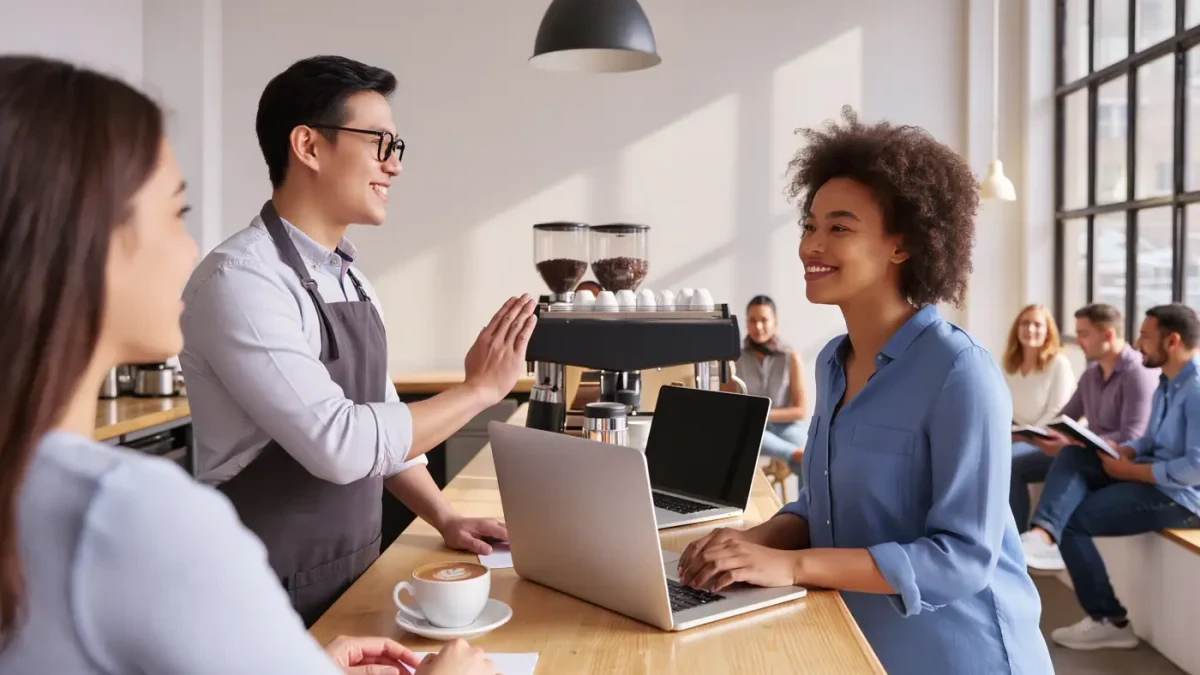
What distinguishes a Signing Store is that communication is engineered into the architecture rather than patched onto a standard template. The layout is open, with clear sightlines so customers and staff can see one another sign. Ordering happens through multiple channels — writing on boards, pointing to menus, digital displays — and the decor itself carries the culture: aprons embroidered with "Starbucks" fingerspelled in ASL, made by a Deaf embroiderer, and murals by Deaf artists on the walls.
The staffing model is the deeper design. Employees include a Deaf store manager and a mixed team of Deaf, hard-of-hearing and hearing signers, which turns every transaction into a bilingual exchange rather than a workaround. In practice, deaf customers order coffee in their first language at a chain register — an utterly ordinary errand that, almost anywhere else, requires improvisation, pointing, patience or an interpreter. Here the default assumes them.
Starbucks had tested the concept internationally first: the company opened its first Signing Store in Kuala Lumpur, Malaysia, in 2016, where employees completed a ten-week sign language course covering both signing and Deaf culture. The D.C. store brought the model to the United States, and in October 2023 it marked five years of operation — by then less a novelty than a fixture of the neighborhood's Deaf community life.
Coffee, community and the informal network
Deaf coffee gatherings long predate any corporate interest. "Deaf coffee chats" — recurring meetups at cafes where signers congregate — are a documented tradition in Deaf communities, an informal social network organized around visibility: a known place, a known time, a language in common. A signing store slots naturally into that ecology, giving the meetup a venue where nobody has to explain themselves to the counter first. Gallaudet students, longtime residents and visiting signers have made the H Street store a stop on that circuit, and its anniversary celebrations drew the community accordingly.
Cultural observers of the store have also noted its symbolic weight. Most accessibility in business is accommodation — a ramp, a caption, a bilingual menu — added to a default that remains unchanged. A Signing Store inverts the default: this business, on this corner, runs in ASL, and hearing customers adapt. That flip, small as it feels over a latte, is what inclusion looks like when it is structural: not a service offered to a minority, but a majority experience simply re-centered.
Hearing customers, meanwhile, get the small experience of being the ones who adapt. The store's multiple ordering channels — writing, pointing, displays — work in every direction, and a hearing visitor can order without speaking just as a deaf one always has everywhere else. The roles reverse for the length of a transaction, which is a modest thing to ask and, for many customers reportedly, a memorable one: inclusion here is not a discount on service but an expansion of who the counter works for.
What one store can and cannot do
It would be too much to load onto one coffee shop. Employment for dozens of signers is real but bounded; a single location cannot shift national norms; and corporate inclusion initiatives earn fair scrutiny about depth beyond launch-week goodwill. Starbucks has since signaled interest in expanding signing-store concepts, though any such plans belong to the company's future rather than the record.
What the record does show is steadier than a press release. Eight years on, the store still opens on H Street, still signs, still draws Gallaudet students past the murals to a counter where their language is the house language. The revolution, such as it is, fits inside an espresso order: a deaf customer walks in, signs, is understood, pays, leaves. No one narrates it as history. It is just Tuesday, finally, in the customer's own language.