Eclipse seasons are the two stretches each year, roughly six months apart, when eclipses can occur, always arriving in pairs. In astrological tradition they are read as accelerators: moments when the ordinary plot speeds up, hidden information surfaces, and chapters close or open abruptly. The astronomy is precise and checkable; the drama layered on top is symbolism, and it should be enjoyed in exactly that spirit, like weather reports written by novelists.
Astrology is an entertainment tradition, not a science; Equality Weekender publishes it as lifestyle content, not prediction or advice.
What is actually happening during an eclipse?
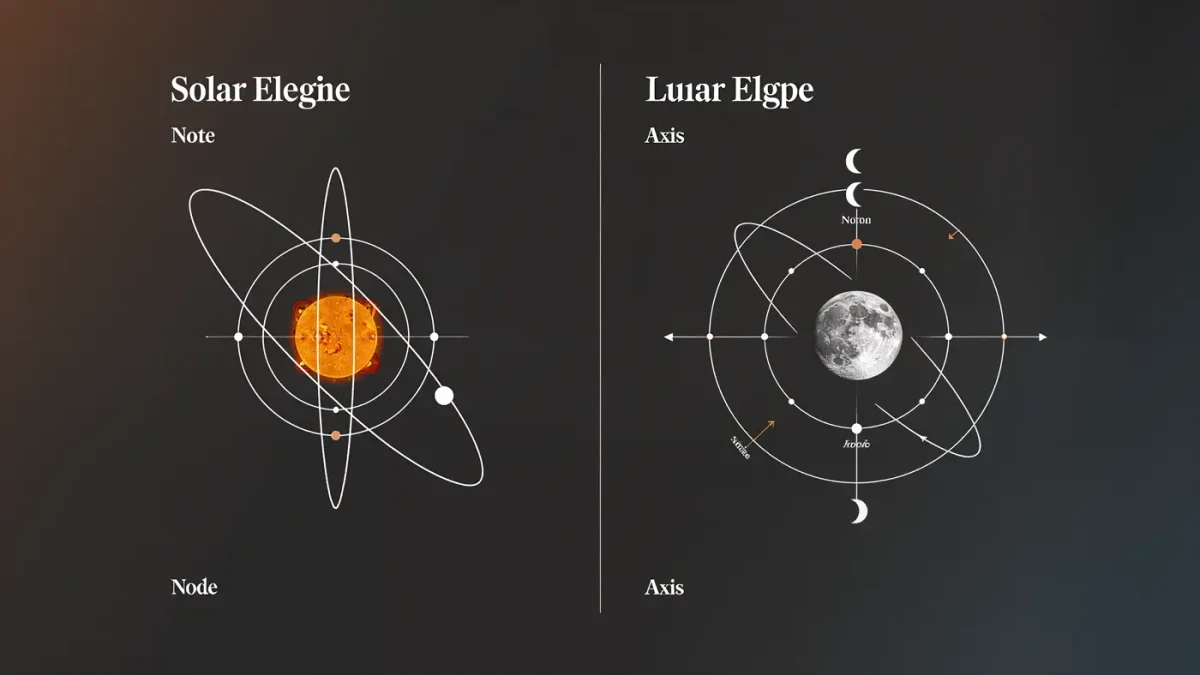
A solar eclipse occurs when the moon passes between earth and sun, briefly casting a shadow; a lunar eclipse occurs when earth sits between sun and moon, tinting the moon copper. Because the moon's orbit is tilted about five degrees from ours, alignments only happen when the new or full moon occurs near the two points where the orbits cross, called nodes. That is why eclipses cluster into seasons of about 34 to 37 days, repeating every six months, and why each eclipse series revisits the same zodiac signs for a year and a half or so before moving on. All of this is orbital mechanics, verifiable to the second.
Why do astrologers treat eclipses as dramatic?
Beyond the sheer spectacle, the tradition's logic is symbolic: an eclipse temporarily switches off the sky's two great lights, the entities a chart treats as its chief characters. A solar eclipse is read as something new beginning under unusual conditions; a lunar eclipse as something culminating or being released, often with feeling attached. Practitioners describe the weeks around eclipses as threshold time, when situations that have been circling for months resolve suddenly, and veils of the kind people maintain about their own lives briefly drop.
What are the classical rules about eclipse seasons?
- Expect revelation rather than decision. The tradition advises letting eclipse-season information arrive before acting on it.
- Hold off on permanent launches, in the spirit of the lore: beginnings started under an eclipse were said to develop unpredictably.
- Watch the houses of your chart that the eclipse degrees touch; astrologers read those life areas as the season's setting.
- Treat strong feelings during a lunar eclipse as weather passing through, not instructions to act immediately.
What is the difference between a solar and lunar eclipse reading?
In the tradition's shorthand, solar eclipses are outward-facing and lunar eclipses are inward-facing. A solar eclipse, always at a new moon, is read as a door opening onto something unplanned, sometimes externally imposed, like a job change or a move. A lunar eclipse, always at a full moon, is read as an emotional climax, the moment a long-building situation becomes impossible to unsee. Astrologers add that eclipse effects were said to unfold over up to six months, which conveniently gives every dramatic event in half a year a chance to qualify.
Do eclipse seasons affect everyone equally?
Practitioners say the intensity depends on whether the eclipse degrees contact planets in your natal chart, and on which houses are involved. For some readers a season passes as a rumor; for others it lands as a live storyline in career, family, or relationship. The tradition also tracks eclipse families, called saros series, each with a reputed character inherited across centuries. It is a beautifully elaborate filing system, and it is worth saying plainly: none of its attributions has survived scientific testing.
How should a sensible person spend an eclipse season?
The same way one spends any scheduled plot twist: with curiosity and loose grips. The astronomical event deserves the wonder it gets; the sun vanishing at midday impressed every civilization that ever saw it, and the folklore is part of that human record. If the tradition's framing helps you pause, observe, and let a situation clarify before forcing it, the season has done its entertainment work. Just keep cause and effect honest: the moon's shadow crosses the sun, not your decisions. Watch the sky, note what surfaces in your life during the same weeks if you enjoy the coincidence, and file the whole experience under the oldest use of astrology there is, which is telling stories about the lights in order to tell them about ourselves.