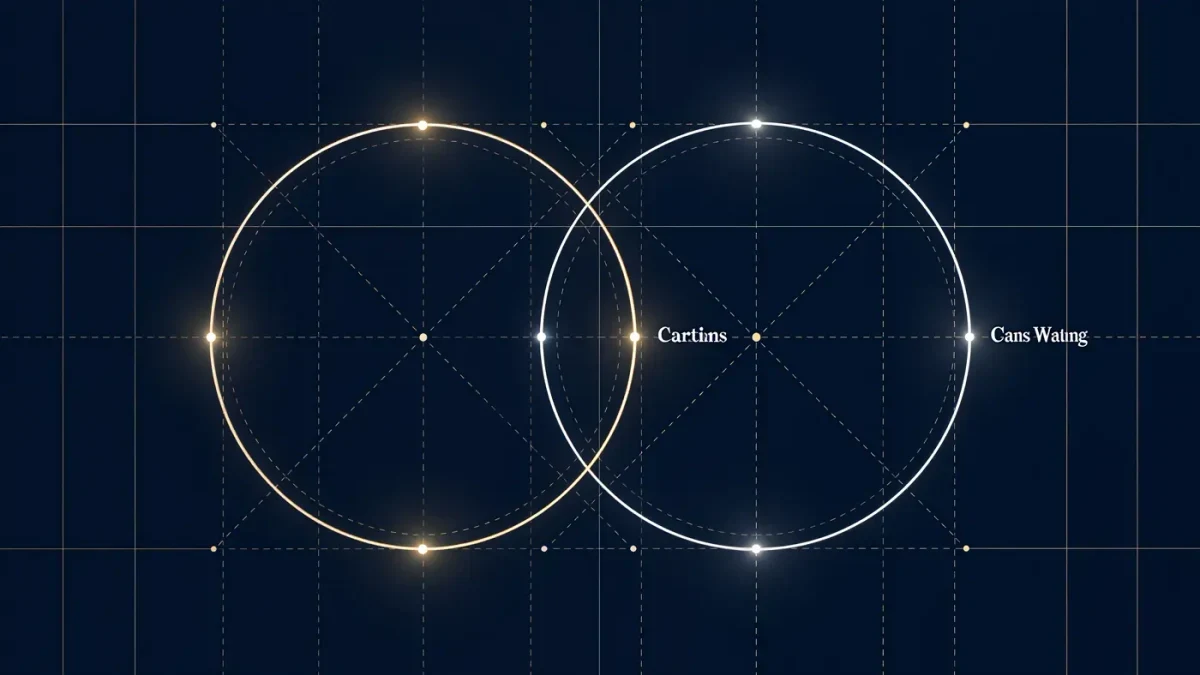
The north node and south node are the two points where the moon's orbital path crosses the sun's apparent path around the earth. They are not objects; they are mathematical points, invisible in the sky but precisely calculable. In astrological tradition the pair forms a compass: the south node is read as talents and habits carried from the past, while the north node is read as the unfamiliar direction of growth. The nodes complete the zodiac in about 18.6 years, which is verifiable astronomy; the compass itself is symbolism.
Astrology is an entertainment tradition, not a science; Equality Weekender publishes it as lifestyle content, not prediction or advice.
What are the nodes, mechanically?
The moon's orbit is tilted about five degrees from the ecliptic, the sun's apparent yearly track. The two orbits cross at exactly two points, always opposite each other, called the ascending and descending nodes. Eclipses can only happen near them, which is why astronomers care about the nodes as much as astrologers do. Because of gravitational tugs, the pair drifts backward through the zodiac, completing the circuit in roughly 18.6 years. When someone says they were born during a nodal return, they mean the nodes had come back around to their birth positions, which happens first near age nineteen.
What does the south node represent in a chart?
In the tradition, the south node is the well: abilities that come effortlessly, patterns so familiar they feel like fate. Practitioners read it as the inheritance side of the ledger, sometimes literally framed as past-life material, sometimes psychologically as early conditioning and family scripts. The catch in the reading is that the south node, however comfortable, is treated as a place of diminishing returns, a chair you have already sat in. Astrologers describe people who over-lean on the south node as skilled but stuck, running old successes on repeat until the groove becomes a rut.
What about the north node?
The north node is read as the assignment: qualities that feel awkward at first and grow satisfying with practice. Where the south node says what you already know how to do, the north node says what you are here, in the tradition's phrasing, to learn. A north node in Capricorn is read as a call toward structure and self-authority for someone whose default is caretaking; a north node in Cancer suggests the opposite migration, from achievement toward tenderness. Practitioners emphasize that nobody is expected to live entirely on the north node, only to keep a foot pointed that way.
How do the nodes pair with the signs?
- Every north node sits opposite its south node, so the pairs always come as complementary axes: Aries-Libra, Taurus-Scorpio, and so on around the wheel.
- Each axis poses one trade-off: self versus partnership, security versus depth, order versus faith, comfort versus change.
- The sign shows the style of the lesson; the house shows the life department where the lesson gets staged, in the tradition's reading.
- The nodal return near ages nineteen, thirty-seven, and fifty-six is read as a scheduled check-in on the compass.
What is a nodal return or nodal reversal?
A nodal return, roughly every 18.6 years, is read as the compass needle resetting: a natural checkpoint for whether life still points toward growth. The opposite event, when transiting nodes cross the natal pair in reverse, is called the nodal reversal and is read as a mid-cycle prompt, often arriving with a sense that the familiar chair has stopped being comfortable. Astrologers tie both to passages of reorientation, which, given the ages involved, conveniently coincide with ordinary developmental crossroads.
How seriously should the compass be taken?
As seriously as any good metaphor, and no more. The nodes' positions and 18.6-year cycle are exact astronomy; the reading of one point as past and the other as future is a storytelling device, unfalsifiable by construction. Its charm is real, though: the axis names a tension most people recognize, between what comes easily and what demands effort, and gives that tension a dignified, sky-sized frame. Read your nodal axis the way you would read a parable about yourself. If it points somewhere useful, walk that way for reasons of your own; if it does not, leave the compass in the drawer where it belongs, next to the telescope that found the crossing points in the first place.