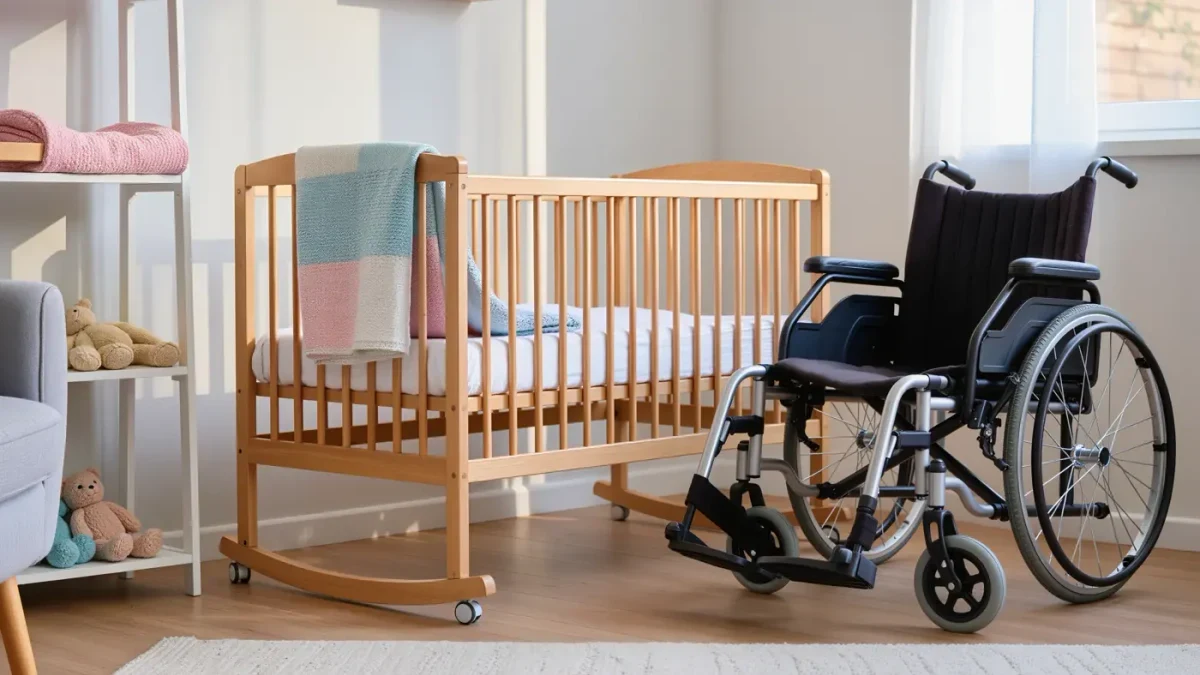
Walk into any baby store and every product assumes two working hands, a standing body and full grip strength. For disabled parents, the useful equipment lives mostly elsewhere: side-opening cribs that let a wheelchair user scoop a baby without lifting over rails, strollers modified with one-hand brakes and low chassis heights, bottle holders and feeding stations built for parents with limited dexterity. Much of it comes from a small, dedicated ecosystem — occupational therapists, volunteer engineer charities and organizations like Through the Looking Glass, the Berkeley-based center that has researched disabled parenting since the 1980s and fields questions from parents and clinicians worldwide.
Why the mainstream aisle doesn't fit
Standard baby gear is engineered around a norm: a standing adult with two hands and average strength. A conventional crib, for example, has fixed high sides — fine for a standing parent, unusable from a seated position. Stroller brakes are foot pedals, harness buckles require pinching two tabs at once, car seats weigh more than many wheelchair users can transfer safely. None of this is a niche complaint; it is the basic geometry of early childcare excluding a whole class of parents from the start.
What disabled parents have done, for generations, is improvise — repurposing kitchen tools, rigging straps, inventing workarounds child by child. The adaptive equipment movement's premise is that the improvising should not have to be solitary: if a problem repeats across thousands of parents, it can be designed for once and shared.
What exists, room by room
In the nursery, the signature item is the accessible crib: a door or drop-gate on the side that opens at wheelchair armrest height, so a parent can slide the baby out laterally instead of hoisting over a rail. Changing tables come in low, open-front versions that accommodate a chair underneath. For parents who are blind or have low vision, talking thermometers, tactile bottle-measuring tools and apps that narrate a baby's environment fill the gaps mainstream design leaves.
Outdoors, the stroller is the central object, and adaptations are practical and varied: extended handles for parents of short stature, one-handed steering and braking setups, wrist straps repositioned for limited grip, and hitches that attach a child's trailer to a power wheelchair the way a bike trailer couples to a bicycle. Feeding brings its own lineup — rocker bottles and braces that hold a bottle steady for a parent with weak arms, weighted utensils later shared with the child, high chairs on locking casters that position a baby at a height a seated parent can reach comfortably.
Who builds the custom pieces?
Some equipment is manufactured commercially, though rarely by the big baby brands. Occupational therapists are the usual matchmakers, prescribing off-the-shelf adaptive items the way they would any assistive technology. But the most distinctive corner of this world is the custom-engineering charity. In the United Kingdom, organizations such as Remap and Demand design and build one-off equipment for disabled people at no cost — a volunteer engineer measuring a wheelchair, a parent and a toddler, then fabricating exactly the bracket, tray or latch that makes a specific task possible.
In the United States, Through the Looking Glass has spent decades documenting adaptive strategies, publishing guides for parents and providers and advising on equipment that commercial makers never produced because the market looked too small to bother with. Independent living centers, which exist in most US regions, often know local fabricators and can help source or fund adaptations. Insurance rarely covers parenting equipment outright — it is not medical in the payer's sense — so funding tends to be cobbled from vocational rehabilitation budgets, family funds and charity builds, a quiet injustice that advocates keep pressing.
What parents say makes the difference
Ask disabled parents which piece of equipment changed their daily life and the answers are rarely glamorous. A crib door that opens one-handed, because the baby is crying and the parent's other hand is braked on a wheel. A sling that keeps an infant stable on a lap through a wheelchair transfer. A baby monitor that flashes a lamp loudly and visibly for a deaf parent. The common thread is autonomy: each item removes a moment where the parent would otherwise need another adult in the room to care for their own child.
That autonomy has a second audience. Disabled parents describe the way strangers — and sometimes relatives, and sometimes child-welfare workers — read assistive improvisation as evidence of inadequacy. Adaptive equipment quietly reframes the scene: a parent using a well-built tool is simply parenting. The gear does not just perform a task; it corrects an assumption.
A market waiting to be normal
The economics keep the field small. Disabled parents are treated as a specialty market, so production runs are short and prices high, which reinforces the specialty label. Designers who have worked in the field point out the obvious: many adaptive features are simply better features. A crib you can open one-handed helps any exhausted parent at 3 a.m. A stroller brake you can reach seated helps a grandparent with arthritis. The curb-cut effect — adaptations built for disabled people that end up serving everyone — applies to baby gear as much as to sidewalks.
Until mainstream manufacturers absorb that lesson, the ecosystem that exists — therapists, engineer volunteers, research centers, parents trading designs in online communities — will keep doing the work one build at a time. It is one of the quietest corners of disability innovation, and for the parents it serves, it is the difference between caring for your child and watching someone else do it.