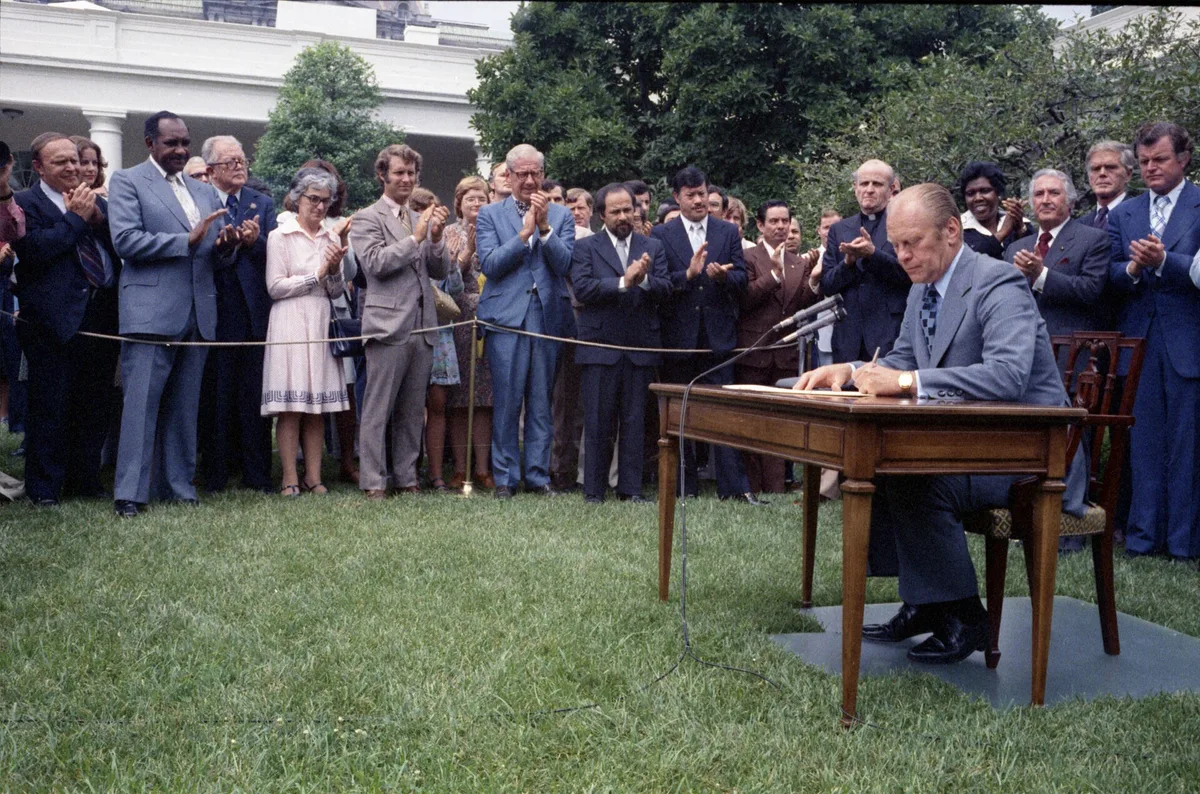
Bilingual ballots became a federal requirement in 1975, when Congress extended the Voting Rights Act to cover language minorities. Under what is now Section 203, jurisdictions with sizable populations of citizens who speak Spanish, Asian, American Indian or Alaska Native languages must provide ballots and election materials in those languages — a rule the Census Bureau recalculates for coverage every five years.
What came before 1975?
A patchwork, and often nothing. Through the nineteenth and early twentieth centuries, some states printed ballots or materials in German, Norwegian or Yiddish for immigrant communities, with no national standard and no entitlement. The pendulum swung hard the other way during and after the First World War, when anti-German sentiment helped drive English-only instruction laws and a broader assumption that voting was a privilege earned through assimilation.
By mid-century, English literacy tests remained a legal tool across much of the South and beyond, used with documented effect to keep Black citizens from the polls. It was against literacy tests that the Voting Rights Act of 1965 was first passed, banning them nationwide for voters schooled in the United States.
Why did Congress add language in 1975?
Because activists made the argument that literacy tests had a cousin. The Mexican American Legal Defense and Educational Fund, founded in 1968 on the model of the NAACP's legal arm, along with Puerto Rican organizations and Native advocates, documented a simple fact: citizens who were fully eligible to vote were being turned away or effectively excluded because election materials existed only in English.
The strongest case came from Puerto Rican communities on the mainland. Puerto Ricans are U.S. citizens by birth, many educated in Spanish on the island — taught in the schools of a U.S. territory — arriving in New York or Chicago to find ballots they could not read. Congress heard testimony along those lines and acted with unusual directness.
The 1975 amendment declared that voting discrimination had extended to language minorities, and that where the democratic process was single-language, citizens educated in another language were denied meaningful access. Section 203 was born.
How does Section 203 work?
It is trigger-based rather than universal. Using census data, the government determines which jurisdictions cross thresholds: more than 10,000 voting-age citizens, or more than five percent of voting-age citizens, in a single language group with below-average English literacy and turnout. Covered jurisdictions must translate registration forms, ballots, instructions and notices, and may need oral assistance at the polls.
Coverage lists are refreshed every five years. Each round adds some jurisdictions and drops others as populations shift, which is why the census — the same count that steers funding — also decides where ballots get printed in a second language.
Which languages are covered?
Four categories: Spanish; Asian languages such as Chinese, Vietnamese, Tagalog and Korean, depending on local populations; American Indian languages; and Alaska Native languages. For Indigenous languages, the challenge is deeper than translation — some have no standard written form across dialects, and the law directs jurisdictions to work with local communities on oral assistance and culturally appropriate materials.
In Alaska, for instance, coverage has included Yup'ik and Gwich'in; in parts of the Southwest, Navajo and Apache-language assistance has been provided through recorded audio and bilingual poll workers rather than written translations alone.
Cost is modest, for the record — translation is a rounding error in election budgets — and election officials in covered counties describe the requirement as settled routine.
What has the mandate changed?
Turnout, measurably in places. Studies following implementation found increased registration and voting among covered language groups, and enforcement actions by the Department of Justice have repeatedly targeted jurisdictions that failed to provide required translations or hired no bilingual poll workers. Latino and Asian American voter participation rose over the decades the mandate has been in force, alongside broader demographic and civic trends.
There have also been fights. Reauthorizations of the Voting Rights Act — 1982, 2006 — renewed the language provisions over English-only objections, and the 2006 reauthorization passed the House overwhelmingly, with the bilingual provisions intact. Court challenges arguing that multilingual ballots exceeded Congress's power failed in the lower courts, and the Supreme Court declined to disturb the mandate.
What does compliance look like in practice?
Covered elections departments translate the full ballot, write their voter guides in each covered language, recruit bilingual poll workers and sometimes record audio for languages without a written standard. The Department of Justice publishes each determination list and has brought enforcement actions where jurisdictions skipped translations, cut oral assistance or failed to staff bilingual positions.
The work is ordinary and constant: every ballot measure, every office, every instruction line, every cycle, in every covered language. Election officials in long-covered jurisdictions describe it as simply how elections are run — an administrative habit with a constitutional pedigree, maintained by translators and county counsel rather than headlines.
Why does it still matter?
Because the population it serves has grown. The number of voting-age citizens who speak a language other than English at home has climbed for decades, and covered jurisdictions now number in the hundreds across dozens of states, from Miami-Dade to Alaska's Yukon delta.
The principle underneath the history is plain and was stated in 1975: citizenship is not conditional on English. A naturalized citizen who studied the constitution in Spanish, a Navajo elder voting in her first language, a young voter in a bilingual household — all are casting the same ballot, in the same republic, in the language in which they think.