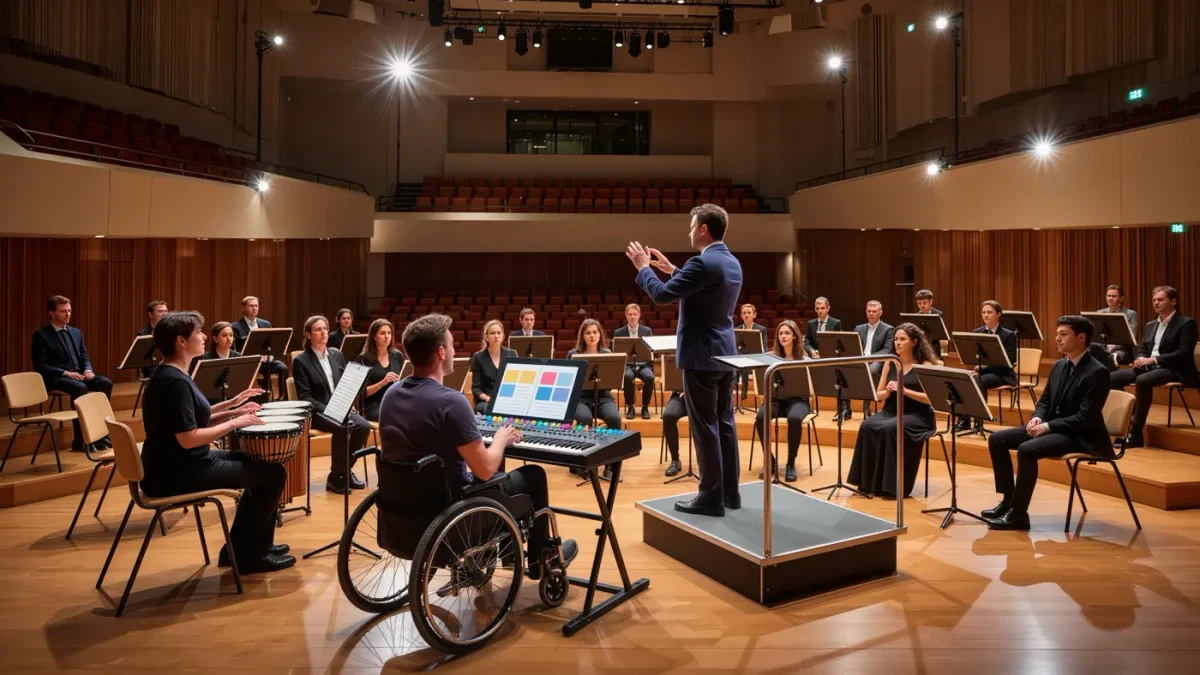
In Switzerland, on a January evening in 2025, the Lucerne Festival — best known for elite orchestras and star conductors — presented a stage work built on a different premise. Called The Big Ensemble, it brought together roughly forty musicians and dancers with and without disabilities, initiated by the inclusive Swiss orchestra Tabula Musica together with HORA'BAND, the band of the disability arts theater HORA Bern, and musicians of the Lucerne Symphony Orchestra. The performance at the KKL Luzern concert hall made its argument physically: an orchestra that changes itself to fit its players, instead of asking the players to fit the orchestra.
Tabula Musica, based in Basel and describing itself as a competence center for barrier-free music, has been setting standards for accessible music-making since 2017, as the Lucerne Festival's own magazine has profiled. The ensemble plays what it calls inclusive music — repertoire developed with adaptive instruments, unconventional notation and rehearsal practices designed so that musicians with cognitive, physical or sensory disabilities are co-authors of the sound rather than guests in it.
What makes an orchestra inclusive?
A symphony orchestra is among the least flexible institutions in cultural life: fixed chairs, fixed technique, fixed audition pipelines that begin excluding in childhood. Inclusive ensembles reverse each assumption. Instruments are adapted or invented — a sensor that turns movement into tone, a table-mounted playing surface, an instrument tuned to a musician's range of motion. Notation becomes color, gesture or call-and-response where written scores would be a wall. And the aesthetic itself shifts: the goal is not to approximate a conventional orchestra with disabled players, but to make music that could only exist because of who is in the room.
The Lucerne Festival's magazine documented this instrument-by-instrument: The Big Ensemble uses inclusive music technology — adaptive instruments that enable performers with a wide range of disabilities to play alongside conservatory-trained symphony musicians. The festival has also framed the project in its public programming as "a stage for all," and its 2024 sustainability report counts the work among its commitments to broadening who classical music is for.
Why a prestige festival bet on this
Lucerne's interest matters because inclusion at the fringe is easy. Community centers host inclusive music nights all over the world; what is rare is a festival of Lucerne's stature placing a mixed-ability ensemble in its main hall, on its main calendar, with its own symphony musicians sharing the stage. That choice answers the quiet doubt that follows disability arts: whether it is "real" art or therapy with an audience. The Big Ensemble treats the question as answered.
The HORA connection deepens the pedigree. HORA Bern is one of Europe's established professional theater companies of artists with disabilities, and HORA'BAND carries that theatrical lineage into music — performers whose stage presence is the point, not an accommodation. When Tabula Musica's orchestral experiment met HORA's performance tradition and the Lucerne Symphony's players, the collaboration produced something none of the three would have made alone, which is roughly the definition of ensemble.
Nor is the moment confined to Lucerne. Inclusive orchestras and adaptive-instrument programs have been appearing across Europe and North America — community ensembles, conservatory partnerships, instrument-builders who hack sensors and software for players the standard instrument industry never designed for. The New York Times, covering Lucerne's broader push for diversity in 2022, noted the debate such changes provoke inside classical music's most conservative rooms. The Big Ensemble is one vivid answer to that debate.
The sound of a different contract
What audiences tend to notice first is not the adaptation but the attention. In rehearsal accounts and festival materials, the ensemble works by listening longer — building pieces from what each player can do, waiting for a phrase to emerge rather than correcting it toward a printed ideal. The music that results has been described as experimental and interdisciplinary: part concert, part theater, part demonstration that skill is a moving target defined partly by who is allowed to show it.
It helps that the project refuses the charity framing entirely. No one in The Big Ensemble is presented as brave for attending, and no one is cast as a patron for sharing a stage. The program credit, the rehearsal hours and the applause are distributed the way they would be in any ensemble — by contribution. In a cultural world that still often applauds disabled artists for showing up rather than for what they made, that ordinary professionalism is itself the radical part.
The deeper contract is about who classical music imagines when it says "musician." For most of the form's history the answer was a narrow body trained a particular way from a particular age. Tabula Musica and its partners propose a wider answer and then, crucially, book the hall, tune the instruments and play — proving the case in the only language the classical world fully trusts, which is the performance itself.