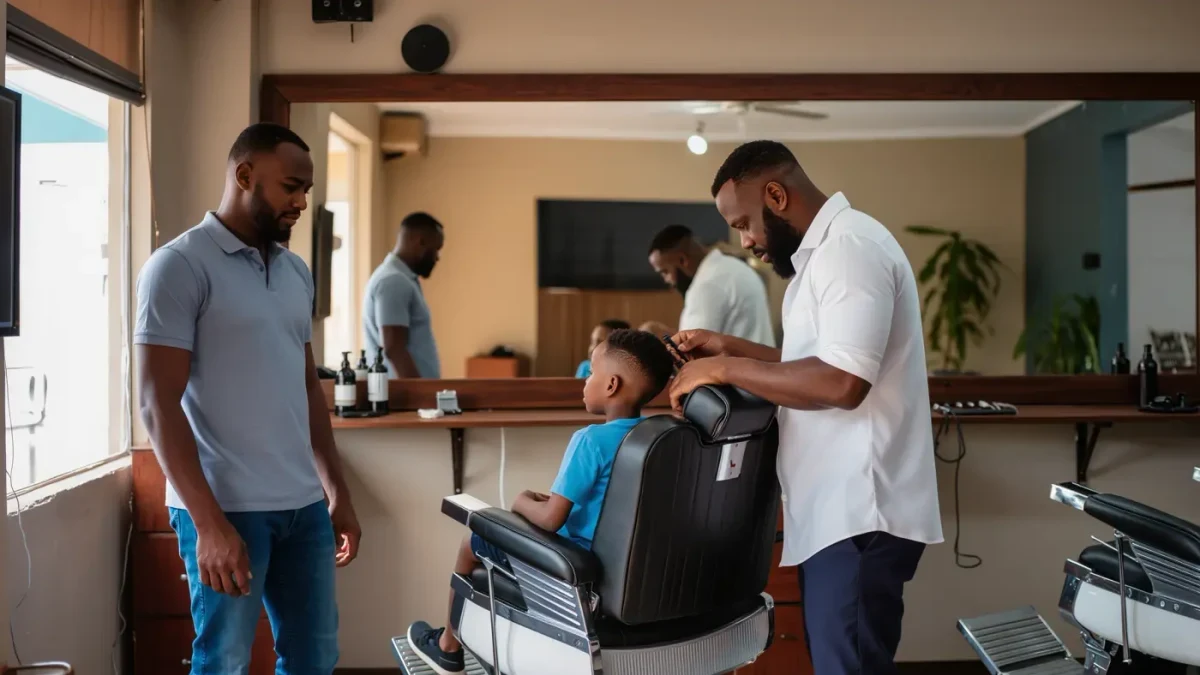
In Cincinnati, Ohio, barber Vernon Jackson owns Noble Barber & Shop and runs something the industry never standardized: a monthly appointment block where children with autism and sensory processing differences get haircuts for free, one child at a time, for as long as each one needs. Jackson created the program — he calls it the Gifted Event — after seeing the need arrive in his own chairs, according to local station WLWT and ABC’s Good Morning America, which have both featured the program. Word spread the way it does among parents: quietly, gratefully, from one waiting room to the next.
Anyone who has watched a haircut go wrong for a sensory-sensitive child knows it is not vanity at stake. Clippers buzz at a frequency that can feel like a drill against the skull; loose hairs itch and scratch; the cape traps heat; a stranger's hands arrive without warning. For autistic children, the experience can register not as inconvenience but as alarm — one reason families sometimes skip haircuts for months, and why the routine chore of childhood becomes a small recurring crisis. Advocacy organizations publish entire guides to it: Autism Speaks distributes a haircutting training guide for families, complete with visual schedules that show a child each step before it happens.
What the Gifted Event changes
The program's design is almost entirely made of adjustments the rest of the trade never had to consider. Children are seen individually rather than in a busy shop's queue, so there is no audience of strangers and no waiting-room noise. Jackson takes as much time as a child needs, following the child's pace rather than the clock — kneeling, pausing, letting a child hold the clippers first or feel the vibration on a hand before it touches hair. Parents describe an environment built to be calm and judgment-free, where a meltdown is a scheduling consideration, not an embarrassment. Beyond autism, the events serve children with Down syndrome, spina bifida and other disabilities, WLWT reported.
None of this requires new technology. It requires the opposite: turning everything down. Quieter clippers, longer appointments, fewer people, permission to stop. What the barber gives up in throughput, the families gain in something rare — a children's service that treats the child's nervous system as the client too.
From chair to institution
As demand grew, the informality hardened into structure. WLWT reported that every haircut under the program is free, funded through a sponsorship campaign that let strangers cover the cost of cuts for children they would never meet — an early sign that the shop’s problem was not persuading people to care, only organizing the caring. Jackson formalized the Gifted Event so that community members and businesses could sponsor haircuts, and he founded a nonprofit, Gifted Alliance, to carry the work — free haircuts for families of children with disabilities — beyond his own shop's capacity. The idea has traveled within the region: a partnership brought an accessible barber shop and hair studio to Wendell Foster, an Owensboro disability services center, extending the model to a part of the state where a sensory-friendly cut previously meant a long drive.
Jackson is not alone in the trade, and that too is the story. Barber-by-barber, in Cincinnati and North Texas and Britain, stylists have been quietly rebuilding the haircut for neurodivergent kids — dimmed lights, silent clippers, first-desensitization visits where no hair is cut at all. The National Autistic Society in the UK maintains a directory of autism-friendly barbers. Autism Speaks has featured how the right supports can turn what it has called a sensory nightmare into a calming experience. What reads as a thousand small kindnesses is also a market correction: an everyday service discovering it had designed itself for only most people.
Why a haircut is worth all this
It is tempting to file sensory-friendly haircuts under nice-to-have. The parents who drive an hour for one would disagree. A haircut is a ticket to school photographs, family weddings, summer camps, jobs — to being read as cared for in a world that reads appearance fast. When a community removes the barrier, it is not merely being gentle; it is reopening doors that the ordinary barbershop, without malice, had closed.
There is also the matter of what the barber gets. Jackson, by the accounts of local coverage, talks about the events as the point of his week rather than a tax on it — the chance to practice the craft he trained for at its most patient and most personal. The chair, it turns out, was never the hard part; thousands of barbers own one of those. The part that needed rethinking was everything around it: the clock, the crowd, the assumptions. Change those, and the haircut — the small, ordinary, human thing — simply happens.