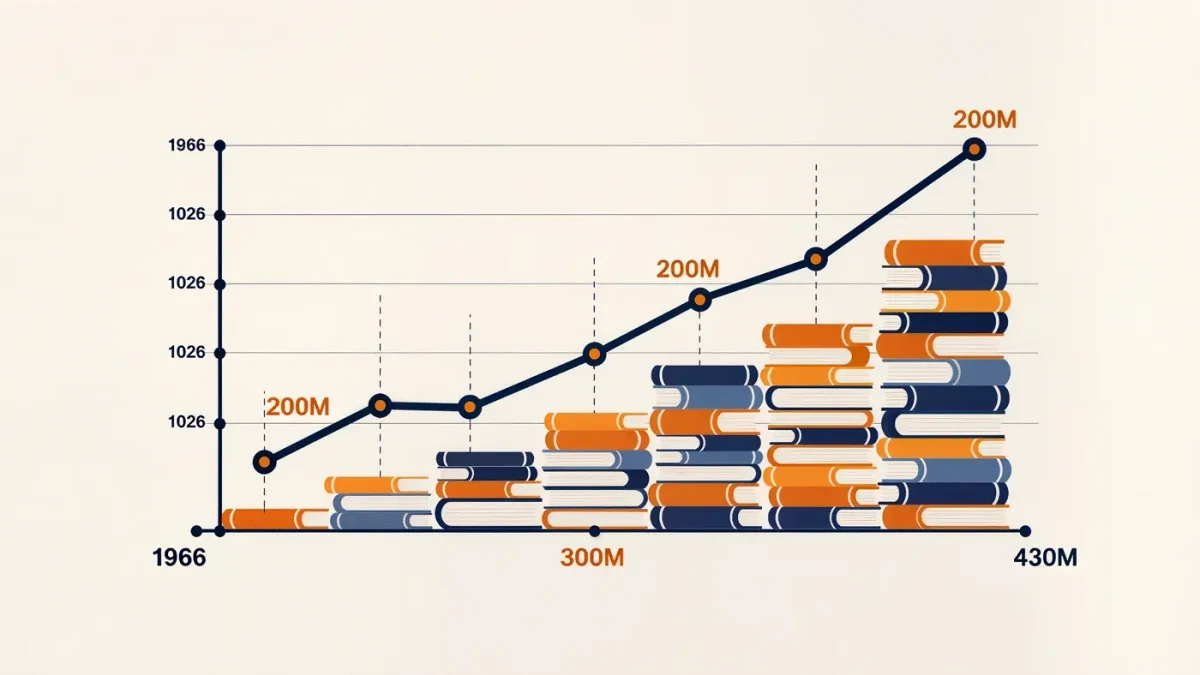
In 1966, in Washington, D.C., Margaret McNamara began gathering books and giving them away to children who had none of their own. Sixty years later, the organization that grew from that act — Reading Is Fundamental, better known as RIF — has distributed more than 430 million books and reading resources to over 212 million children across the United States. The idea was radical only in its simplicity: children who choose their own books, and keep them, become readers.
The founding story has become organizational scripture. McNamara, a teacher and volunteer, tutored children in Washington and was struck that many of them had never owned a book. She assembled a small collection, let each child pick one, and watched what the act of choosing did to the act of reading. The model that RIF still runs on — book distribution through schools and community sites, with children selecting from a spread of titles rather than being assigned one — was born in those first giveaways.
Why the choosing matters
RIF's signature insight is the difference between a book handed over and a book picked out. Decades of literacy practice have converged on the same observation RIF made empirically: ownership and choice convert reading from a task into a possession. A child with a shelf of her own books, each one selected by her, returns to them differently than a child who only ever meets books on a desk.
The mechanism was scale. RIF did not open a flagship library; it went through existing infrastructure — schools, Head Start centers, libraries, community programs — and supplied the books, the discount purchasing power and the playbook for local volunteers. At its height the network ran through tens of thousands of sites, reaching children in districts where school libraries were threadbare and bookstore trips were not a part of life. By RIF's own accounting, more than 212 million children have been reached since 1966.
Surviving the hard years
The organization's history is also a case study in what happens when a beloved national program meets federal budget politics. RIF's book distribution had long been supported by federal funds, and in 2011 Congress eliminated that support entirely, an event widely covered as the moment the country's largest children's literacy nonprofit lost its backbone overnight. RIF restructured, leaned on corporate and philanthropic partners and private donors, and kept distributing — more slowly, more deliberately, but continuously.
The transition was not cosmetic. It forced RIF to articulate, in grant applications and public campaigns, why free book ownership mattered in a country that had decided the market could handle it. The organization began publishing research summaries on book access and the so-called book gap — the finding that homes in low-income neighborhoods contain far fewer books than those in affluent ones — turning six decades of anecdote into an argument. Literacy, RIF argued, is not a personality trait; it is infrastructure, and it is unevenly laid down.
The numbers stayed serious even in lean years: in fiscal 2022 alone, according to the charity tracker America's Charities, RIF provided 5.8 million books to children. And the definition of a "book" expanded with the technology. RIF's digital platform, Skybrary, carries the giveaway logic onto screens, and the organization now promotes a goal of 100 free books to every child through the app — the same 1966 instinct, re-engineered for a century when the library fits in a pocket.
What six decades taught
RIF's endurance reflects a few stubborn commitments. It never wavered from free — not discounted, not loaned — as the terms of the transaction. It never abandoned choice, even though letting six-year-olds pick their own titles is messier than shipping a standard crate. And it kept its identity local: the books arrive through teachers, volunteers and community sites who know the children by name, which is why the giveaways still feel like events rather than deliveries.
The nonprofit field around childhood literacy has grown crowded since 1966, with celebrity book clubs, subscription boxes and municipal initiatives all working the same problem. But most of them are younger than RIF's alumni. There are grandparents today who picked a paperback off a RIF table in 1971, kept it on a shelf for decades, and raised children in a house where books were assumed — and those children raised readers of their own. Intergenerational literate habits are difficult to measure and impossible to fake. That is the compounding return on 430 million small choices, each one a child somewhere holding a book that no one would ever ask to have returned.
McNamara died in 1981, fifteen years in, having seen the idea outgrow any single classroom. The organization she started now marks its anniversary not with a monument but with the only statistic that ever mattered to it: books given, children reading, the count still running.